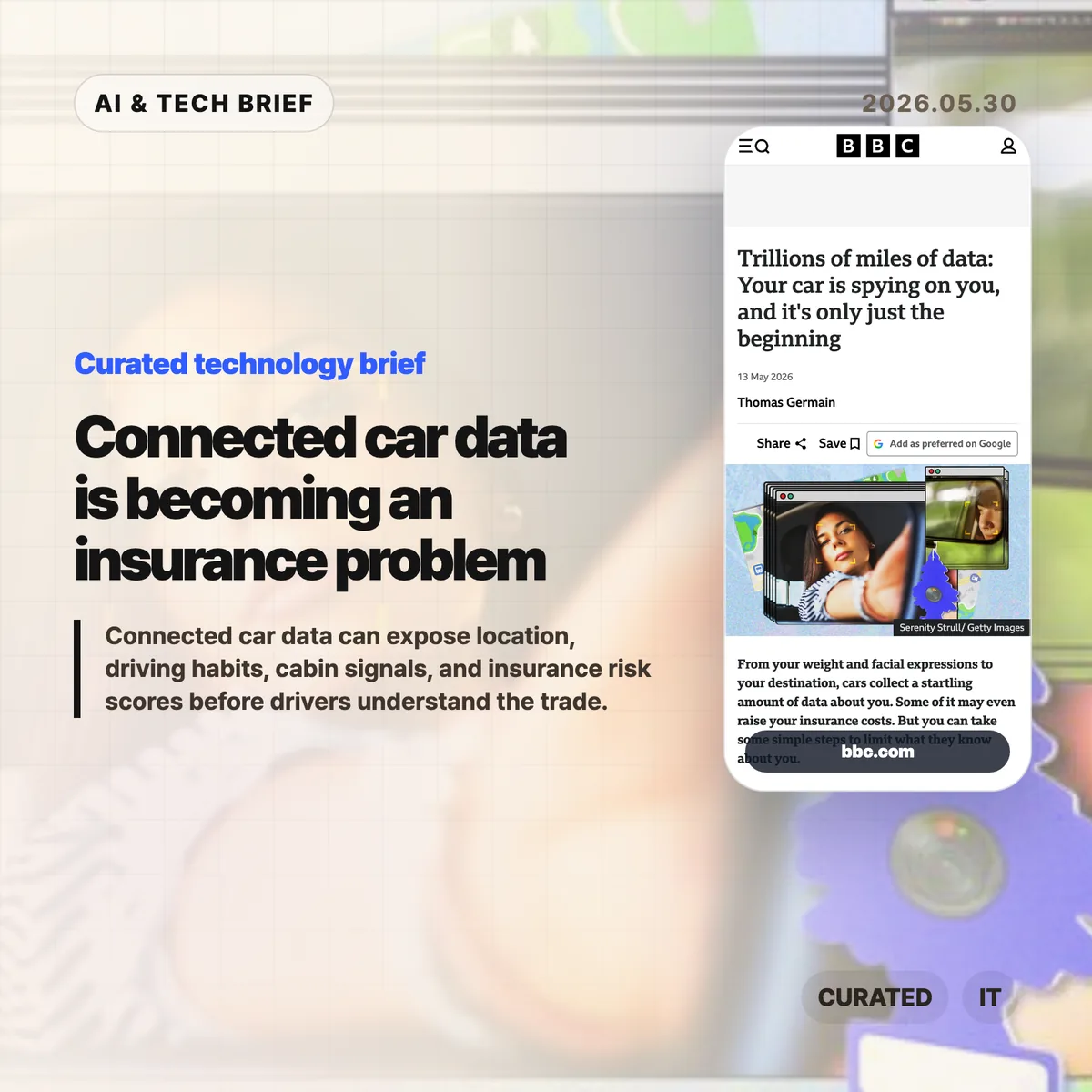
Connected car data is no longer a small diagnostic trail that stays with the vehicle. Modern cars can record where you go, how you drive, who may be in the cabin, and whether your behavior looks risky to an insurer. The uncomfortable part is that many drivers meet this system through a discount offer, a companion app, or a checkbox on a dashboard screen.
Table of Contents
The short version
- BBC Future reports that cars can collect precise location, driving behavior, cabin sensor signals, infotainment choices, and clues about passengers.
- A cited driver found about 130 pages of LexisNexis driving and movement records, then saw an auto insurance quote rise by 21%.
- The FTC finalized an order over GM and OnStar’s handling of geolocation and driving behavior data, including a 5-year bar on sharing certain sensitive data with consumer reporting agencies.
- Hacker News readers focused less on the headline shock and more on practical defenses: pulling cellular modules, disabling telemetry, and buying older cars.
- The useful test is simple: if a car feature sends connected car data off the vehicle, drivers should know who receives it, how long it is kept, and whether it can affect pricing.
What happened
BBC Future framed the modern car as a rolling computer that can collect a startling amount of personal information. The piece points to data categories that go beyond mileage and fault codes: precise location, acceleration, hard braking, seatbelt use, radio choices, cabin camera signals, and in some systems clues about weight, age, facial expression, or impairment.
The insurance angle makes the privacy issue concrete. Telematics programs are sold as a way to reward safer driving, but the outcome is not always a discount. BBC cited a Maryland analysis in which 31% of participants received lower rates, 24% received higher rates, and 45% saw no change.
Regulators are already treating this as more than a hypothetical risk. In January 2026, the FTC finalized an order settling allegations that GM and OnStar collected and sold precise geolocation and driving behavior data without adequate consumer consent. Under the order, GM cannot provide certain sensitive location and driving behavior data to consumer reporting agencies for 5 years.
How connected car data reaches insurers
The path is rarely visible from the driver’s seat. A vehicle can send telematics through a built-in modem, a manufacturer account, a dealer service system, a phone app, or an insurance program. Once connected car data leaves that stack, it can be packaged into risk signals that feel far removed from the screen where the driver first tapped accept.
Why this is worth watching
Connected car data is unusually intimate because it ties behavior to place. A phone location trail can be sensitive, but a vehicle trail can also reveal school runs, medical visits, religious services, shift work, passengers, and driving style. When that data enters insurance or consumer reporting systems, the driver may not know what record exists until a price changes.
Mozilla’s car privacy review adds another reason to take the issue seriously. It found that many car brands claim broad rights to collect and use personal information, including location, driving behavior, financial details, and in some policies more sensitive categories. That does not mean every car records every possible field. It does mean the paper permissions are often wider than a buyer expects when signing up for a vehicle app or connected service.
This also matters for product teams building around vehicles. A mobility app, insurer app, fleet dashboard, or driver monitoring feature may feel like a narrow utility, but users experience it as part of the car. If the privacy model is vague, the product inherits the mistrust aimed at automakers and brokers. For more coverage of privacy-heavy technology stories, see the IT & AI archive.
What Hacker News readers are arguing about
The Hacker News discussion was more practical than ideological. Some readers joked that they prefer old cars with no networked electronics. Others described real attempts to take newer cars offline, including removing a cellular bridge, pulling a fuse, or using model-specific tools to disable telemetry.
The strongest technical objection was that disconnecting the modem may not be enough. Several commenters pointed out that a car can store data while offline and upload it later, either when connectivity returns or when a service tool touches the vehicle. That turns “just pull the module” into a partial fix rather than a clean answer.
The more useful builder point is that the privacy boundary is hard to explain to normal drivers. A car has internal networks, external connectivity, dealer diagnostic tools, manufacturer apps, insurer programs, and third-party data brokers. A privacy screen that says “connected services” does not tell a driver which of those systems still has a path to their data.
The practical read
Drivers do not need to panic, but they should stop treating connected services as free extras. Before enabling an automaker app, a usage-based insurance program, or a driver monitoring feature, check whether the service shares connected car data with insurers, consumer reporting agencies, affiliates, or marketing partners.
The best first pass is boring and useful: review the vehicle’s privacy settings, the manufacturer app, any insurance telematics app, and the data request or opt-out forms offered in your region. EFF maintains a guide for finding out what a car may know about you and how to opt out when the manufacturer allows it.
For automakers and app builders, the lesson is harsher. Consent cannot be buried in a setup flow and still feel legitimate when the result may affect insurance prices. If a feature needs cabin, location, or driving behavior data, say so plainly, limit the use, and make deletion or sharing controls easy to find.
Sources
- Trillions of miles of data: Your car is spying on you, and it’s only just the beginning
- Hacker News discussion
- FTC finalizes order settling allegations GM and OnStar collected and sold geolocation data
- Cars are the worst product category Mozilla has reviewed for privacy
- How to figure out what your car knows about you
- NHTSA advanced impaired driving prevention technology report