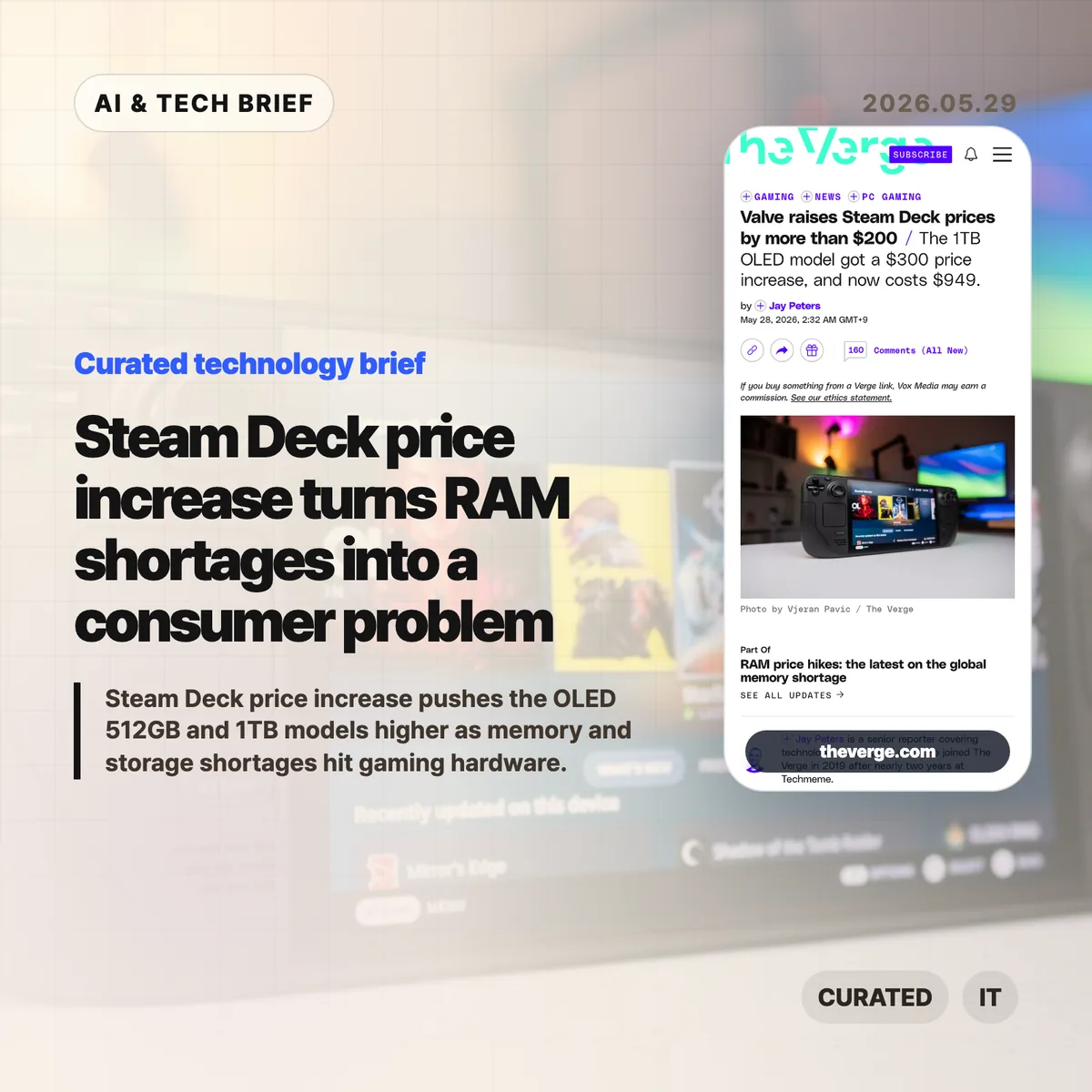
The Steam Deck price increase is the clearest sign yet that the memory crunch is reaching ordinary gaming hardware. Valve’s 512GB Steam Deck OLED now costs $789, up from $549, while the 1TB OLED model now costs $949, up from $649. Nothing changed about the handheld itself. The bill got larger because memory, storage, and logistics got harder to absorb.
Table of Contents
The short version
- Valve raised Steam Deck OLED prices by $240 on the 512GB model and $300 on the 1TB model, according to The Verge.
- Valve cited rising memory and storage costs, not a new chip, screen, battery, or hardware revision.
- The same shortage has already complicated Valve’s Steam Machine and Steam Frame timing.
- Hacker News readers mostly treated the news as a wider hardware price shock, with RAM price anecdotes doing a lot of the emotional work.
- For more short tech briefs like this, see the IT & AI archive.
What happened
Valve brought the Steam Deck OLED back into stock with higher prices. The 512GB model moved from $549 to $789, and the 1TB model moved from $649 to $949. The Verge reported that both models were listed with estimated delivery in three to five business days at the time of writing.
Valve’s explanation was blunt: “rising memory and storage costs.” The company also pointed to component costs and global logistical challenges across the industry. That matters because this is not a product refresh. Buyers are being asked to pay more for the same Steam Deck OLED.
The refurbished market moved too. The Verge noted refurbished OLED units at $629 for 512GB and $759 for 1TB, which now sit awkwardly close to the old new-unit prices.
Why this is worth watching
The Steam Deck price increase is easy to file under “gaming news,” but the more useful read is supply chain math. Handheld gaming PCs use the same broad memory and storage markets that laptops, desktops, servers, and AI infrastructure pull from. When those parts get scarce, a device that once looked locked to a familiar consumer price band can suddenly break out of it.
Valve is not alone. The Verge points to Lenovo’s Legion Go 2 price increase and recent console price moves from Sony and Nintendo. Each company has its own product mix and regional pricing story, but the pattern is hard to ignore: new gaming hardware is getting harder to price like last cycle’s hardware.
The second-order effect is product timing. Valve had wanted to ship the Steam Machine and Steam Frame in early 2026, but memory and storage shortages have pushed those plans out. If you build hardware, this is the uncomfortable part. Component pricing does not stay in a spreadsheet. It leaks into launch dates, inventory, refurbished pricing, and how much risk a company can take on margin.
Steam Deck price increase in context
For buyers, the Steam Deck price increase changes the value equation. At $649, the 1TB OLED model felt like an aggressive handheld PC. At $949, it sits much closer to laptops, Windows handhelds, and console-plus-accessory bundles. The device may still be good, but the comparison set changes.
For developers, the pricing shift is a quiet platform question. If handheld PCs get more expensive, the addressable audience for optimized portable PC gaming may grow more slowly. That does not kill the category. It does mean game teams should be careful about assuming that every interested player will upgrade on the same schedule as before.
There is a practical product lesson here too. Software companies can often hide infrastructure cost changes for a while through pricing tiers or usage limits. Hardware companies have fewer cushions. If DRAM and SSD costs spike, the box on the shelf eventually reflects it.
What Hacker News readers are arguing about
The Hacker News discussion was less about Valve specifically and more about what this says about buying technology in 2026. Several commenters compared the Steam Deck jump with their own RAM purchases. One person said a 96GB DDR5 kit bought for about $350 in late 2024 was now listed around $1,300. That kind of anecdote is not a market dataset, but it explains why the thread felt so irritated.
The practical worry was Valve’s next hardware. Commenters asked how a Steam Machine can stay under $1,000 if the handheld already moved this much. Others worried about the Steam Frame, because a higher base bill for memory and storage makes any new headset or living-room PC harder to position.
There was also a split in buyer behavior. Some readers were glad they already bought an OLED Steam Deck. A few joked that laziness had made their old LCD models more valuable. Others said the new price would stop them from buying at all. That is the part Valve has to care about: a price increase can preserve margin while shrinking the group of people who see the product as an easy impulse buy.
The useful counterpoint came from people arguing that scarcity might force better optimization. If RAM, storage, and device prices keep rising, bloated games and sloppy system requirements become harder to defend. That is more hope than forecast, but it is the one optimistic thread in an otherwise sour conversation.
The practical read
If you were planning to buy a Steam Deck OLED, the old price anchor is gone. Compare it against refurbished Decks, Windows handhelds, laptops, and the games you actually play before treating it as the default portable PC choice.
If you build games, keep low-power and lower-memory profiles on the roadmap. The Steam Deck price increase does not mean handheld PCs disappear, but it does make the installed base more sensitive to price, repair life, and upgrade timing.
If you work on hardware, watch memory and storage pricing before you promise a launch window. Valve’s example shows how quickly component pressure can turn into public pricing and schedule pressure.