An AI-native startup is not defined by the model it buys. The stronger test is whether the company maps repeated work, gives agents enough context, grades their output, and improves the loop every week. That is the practical argument in cyber.fund’s May 2026 guide by Stepan Gershuni, and it is more useful than another list of agent tools.
Table of Contents
The short version
- The cyber.fund guide frames an AI-native startup as an operating model: agents execute more repeat work while people keep direction, judgment, relationships, validation, and accountability.
- Founders should start by listing recurring work from the last two weeks, then classify it by autonomy level before picking tools.
- The durable asset is context: company rules, customer facts, decisions, source links, and examples that any model can use.
- Evals turn agent work from a demo into a system, because teams can score whether each run was good enough to trust.
- The weekly moat is not model access. It is the discipline to tighten skills, context, permissions, and review gates before scaling autonomy.
What happened
cyber.fund published “How to Build an AI-Native Startup” on May 25, 2026. The article argues that founders should stop treating AI adoption as a tooling upgrade and start treating it as a redesign of company operations. The opening example compares two startups in the same market: one spends the morning clearing yesterday’s support tickets and dashboards, while the other has agents triage tickets, refresh metrics, and surface churn risk overnight.
The piece then turns that story into a six-part operating system: map the work, build the context system, choose the simplest automation that works, encode repeated work as skills, write evals, and run a weekly feedback loop. That structure matters because it gives founders a way to separate useful automation from agent theater. A script may be right for link checking or JSON validation. A workflow engine may be right for call summaries and CRM notes. An agent may be right for open-ended bug investigation or messy customer research.
Why AI-native startup is worth watching
An AI-native startup is worth watching because the advantage shifts from access to intelligence toward the quality of the company’s operating memory. Most teams can reach similar frontier models. Fewer teams can keep clean source-linked customer context, clear permissions, reusable skill files, and evals that tell them when agent output is safe to use.
The guide’s most concrete advice is simple: list the recurring work from the last two weeks. Customer-call notes, lead research, outbound drafts, support triage, QA, onboarding, release notes, investor updates, weekly metrics, bug reproduction, recruiting screens, and invoice review all become candidates. The useful filter is frequency plus reversibility. Daily support tagging may be less glamorous than an automated strategy memo, but it runs often enough to create better ground truth. Rare, high-trust, unstable work should stay human-led or human-approved.
What does an AI-native startup change for builders?
An AI-native startup changes the builder’s job from writing one-off prompts to designing repeatable work systems. Builders have to decide which tasks need scripts, which need deterministic workflows, which need human approval, and which are open-ended enough to justify an agent. That decision is product architecture, not prompt polish.
The source article is especially sharp on context. It recommends a shared, versioned context layer that agents can read: company notes, product facts, customer lessons, decisions, source links, schemas, and permission boundaries. Git is a reasonable starting point because it is diffable and human-readable. Raw material and distilled conclusions should stay separate. A transcript is raw. A customer objection, renewal risk, owner, follow-up date, and source link are distilled. If teams blur those layers, they end up with plausible summaries that nobody can verify.
For more coverage of practical AI operations and product building, see the IT & AI archive.
What the discussion is missing
There was no Hacker News thread available for the article in the public HN search index when this brief was prepared. The missing debate is still easy to name: the guide is strongest as an operating checklist, but it leaves several hard implementation questions for founders to answer themselves.
The first question is security. Agent identity, scoped credentials, audit logs, cost caps, retry caps, approval gates, and production-write limits need code-level enforcement. A prompt that tells an agent not to touch production is not a boundary. The second question is measurement. A team can say it has automated support triage, but the useful metrics are acceptance rate, override rate, cost per run, cycle time, review time, and incident count. The third question is morale. If repeated work becomes a skill file, managers need to be honest about which roles gain leverage and which roles lose scope.
The practical read
For founders, the useful move is to run a small audit before buying another agent platform. Write down every recurring task from the last two weeks. Pick three: one personal workflow such as inbox triage, one customer-facing workflow such as call synthesis, and one internal workflow such as test generation or weekly metrics. Keep each workflow narrow enough that a bad output can be spotted and reversed.
Then write the eval before chasing autonomy. For customer-call synthesis, label a set of past calls with expected facts, objections, risks, follow-ups, and owners. Add deterministic checks for names, dollar amounts, dates, links, and schema validity. Use a judge model only for the parts that deterministic checks cannot reach, such as whether the summary reflects the actual call. If the acceptance rate stays below roughly 70%, the answer is usually not a bigger model. Narrow the scope, load better context, add examples, or add an escalation rule.
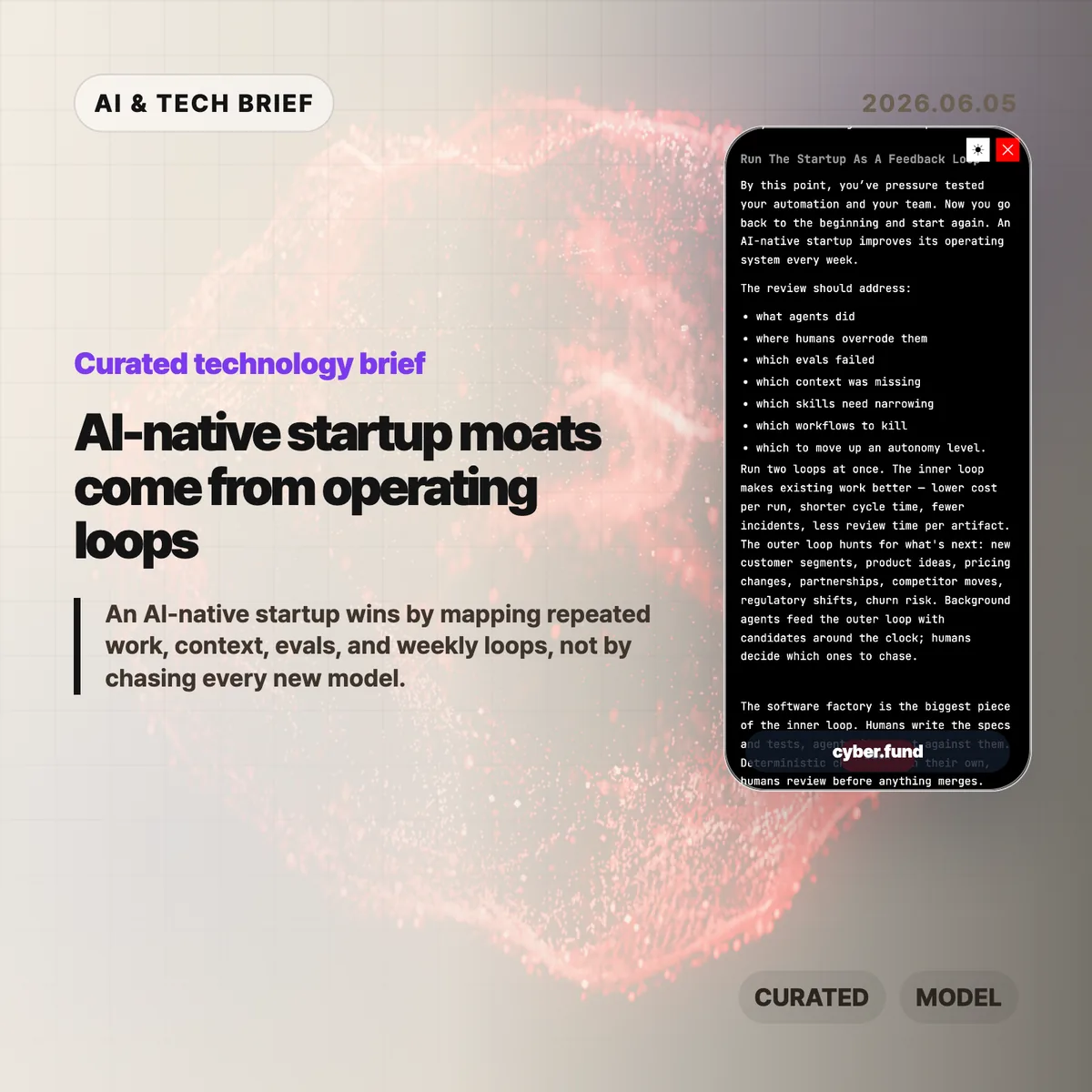
That is the real AI-native startup test. The company should be able to say what agents did this week, where people overrode them, which evals failed, which context was missing, which skills were narrowed, and which workflows should move up or down an autonomy level. If that review happens every week, the operating loop compounds. If it does not, the startup is only using AI tools.