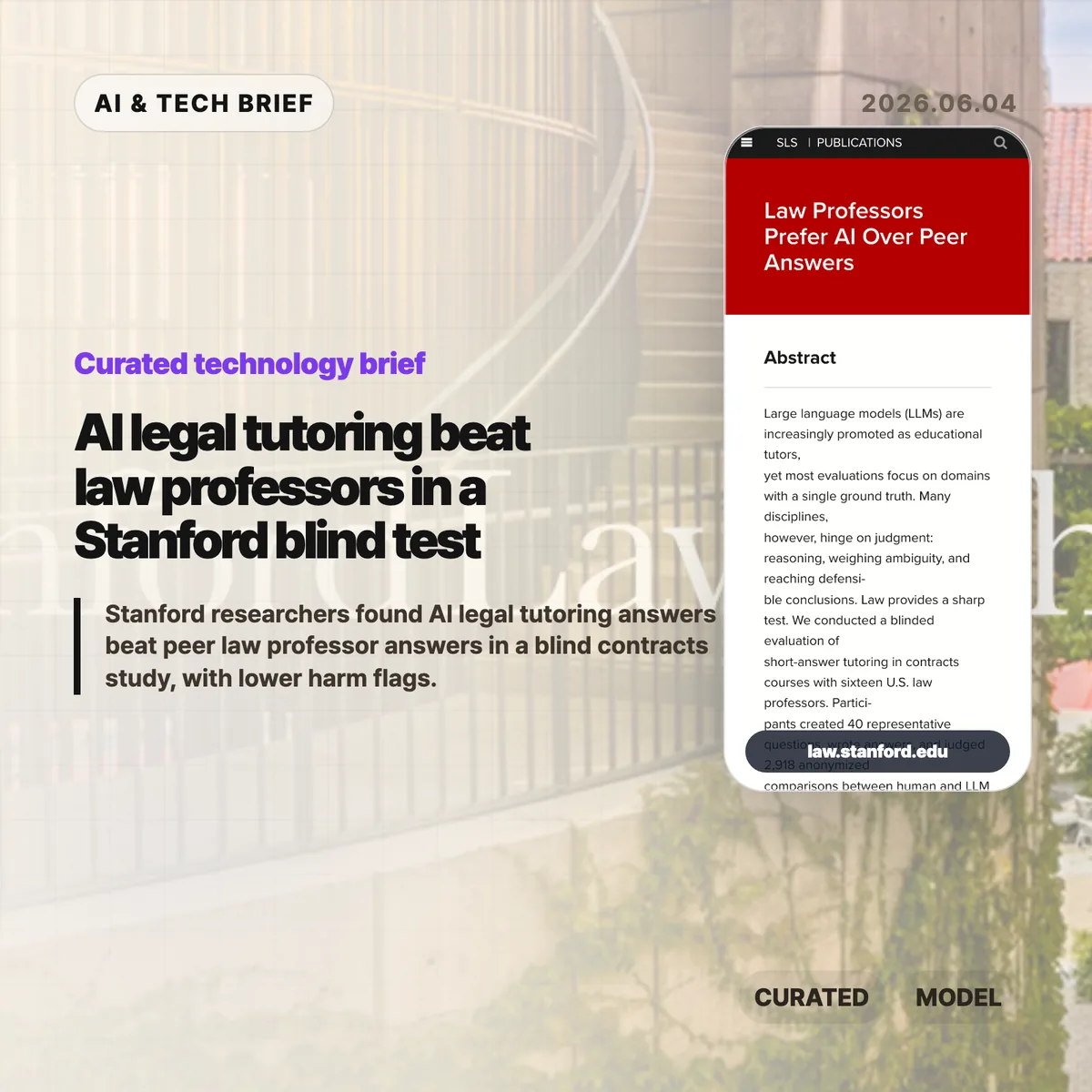
AI legal tutoring looks more credible after a Stanford Law School study found that law professors preferred LLM-generated answers to peer-written answers in a blind contracts exercise. The result does not make AI a law professor. It does suggest that well-scoped tutoring systems deserve a more serious test than the usual chatbot panic.
Table of Contents
The short version
- Stanford Law researchers ran a blinded evaluation with 16 U.S. law professors, 40 contracts questions, and 2,918 anonymized comparisons.
- Professors preferred LLM answers over peer professor answers at an average win rate of 75.33%, according to the study page.
- Professors flagged LLM answers as harmful 3.53% of the time, compared with 12.06% for professor-written answers.
- The study tested short-answer tutoring in contract law, a field where ambiguity and defensible reasoning matter more than one right answer.
- The practical question is no longer whether AI legal tutoring can produce polished answers. Schools now need to test when students learn more, when they over-trust the tool, and who reviews the hard cases.
What happened
Stanford Law School published “Law Professors Prefer AI Over Peer Answers,” a 61-page Social Science Research Network article dated May 27, 2026. The study was led by Julian Nyarko and Alejandro Salinas with a large group of co-authors from Stanford, Yale, NYU, the University of Chicago, and other law schools.
The design was straightforward enough to matter. Sixteen U.S. law professors wrote 40 representative questions that students might ask after class or during office hours in contracts courses. The professors wrote their own answers, then judged anonymized comparisons between human and LLM responses without knowing the source. Stanford says the researchers calibrated AI responses to match the length and structure of human answers.
The headline number is hard to ignore: LLM responses won 75.33% of the comparisons. The paper also says model answers performed similarly to the best instructor in the study. That is a narrow result, but it is a useful one because the task was not a multiple-choice benchmark or a memorized rule lookup.
Why AI legal tutoring is worth watching
AI legal tutoring is worth watching because law is a stronger test than many classroom AI benchmarks. Contract law questions often require students to weigh competing arguments, apply doctrine to messy facts, and explain why more than one answer can sound plausible. A system that performs well in that setting may be useful in other judgment-heavy fields too.
The harm flags are the part that should get administrators’ attention. Professors marked LLM answers as potentially harmful 3.53% of the time, versus 12.06% for peer-written answers. That does not prove the models are safer in live classrooms. It does show that expert evaluators did not see the AI answers as unusually reckless in this controlled setting.
There is also a product lesson here. The study did not ask a general chatbot to wander through legal education with no guardrails. It used a defined domain, representative student questions, matched answer formats, and expert review. That is closer to how serious AI education products should be evaluated.
What does AI legal tutoring change for schools?
AI legal tutoring changes the burden of proof for schools that treat all student-facing AI help as low quality by default. A ban may still be reasonable for exams, graded writing, or professional responsibility training. For office-hour-style explanations, schools now have evidence that a scoped LLM tutor can meet a professional standard in at least one law-school setting.
The next question is learning, not answer preference. A professor may prefer a polished answer in a blind comparison, while a student may still learn less if the tool removes the struggle of forming an argument. Schools should test retention, transfer to new fact patterns, citation habits, and overreliance before putting AI into a required course workflow.
Builders should take the same lesson. Education apps and legal study tools need domain-specific evaluation, not generic leaderboards. The strongest version of this product is probably a supervised layer: quick explanations, counterarguments, follow-up prompts, and a clear route back to a human instructor for disputed or high-stakes questions. For more coverage of applied AI and education tools, see the IT & AI archive.
What Hacker News readers are arguing about
The Hacker News discussion exists, but there was no substantive thread to summarize when checked. The item links directly to the Stanford PDF and shows no comment tree, so there is no community consensus, skeptical argument, or repeated technical objection to report from that source.
That absence matters a little. A result this strong should attract questions about sample size, prompt construction, model selection, answer-length matching, and whether the evaluators preferred fluent structure over durable student learning. Those are the objections readers should bring to the paper itself rather than treating the 75.33% win rate as a deployment recommendation.
The practical read
For schools, the Stanford result supports pilots rather than blanket adoption. Start with low-stakes, office-hour-style help. Log the question types. Measure whether students can explain the reasoning later without the tool. Require clear disclosure when students use AI help for assignments, and keep exams and professional judgment exercises under stricter rules.
For builders, AI legal tutoring should be designed as a narrow product with evaluation built in. The useful features are not only better answers. Teams need source controls, uncertainty labels, counterargument prompts, instructor review queues, and analytics that show whether students are asking better follow-up questions over time.
For lawyers and legal educators, the uncomfortable part is that peer-written answers were not automatically better. The useful response is to define where human teaching adds value: feedback on a student’s reasoning, ethical judgment, classroom debate, and the moments when a neat answer hides a bad assumption.