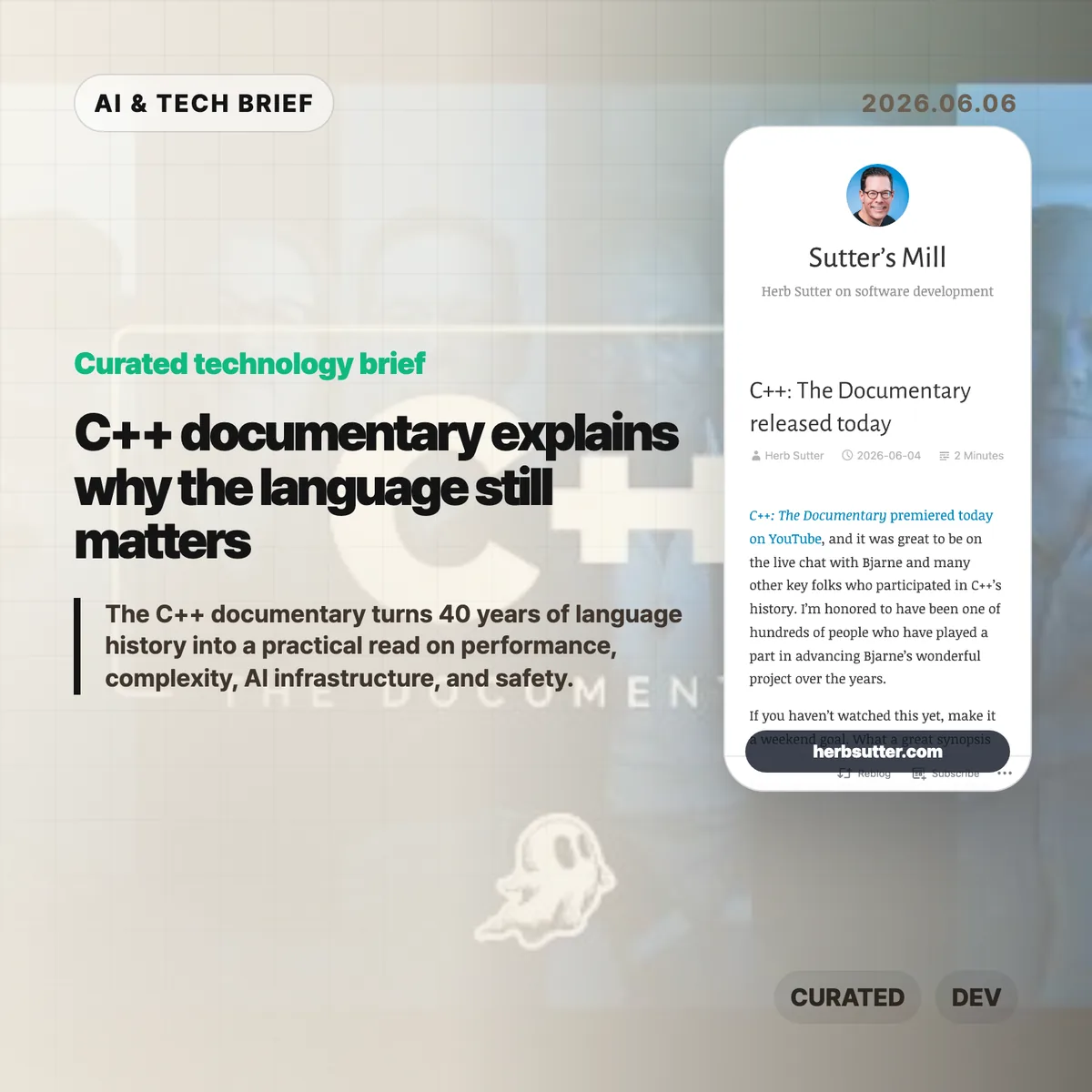
The C++ documentary released this week is more than a nostalgia piece for systems programmers. It gives developers a compact way to understand why C++ has survived for roughly 40 years, why it still powers performance-heavy software, and why the language remains difficult to replace in AI infrastructure, trading systems, games, embedded software, and scientific computing.
Table of Contents
The short version
- The C++ documentary premiered on YouTube and was highlighted by Herb Sutter, who points to C++ as a 40-year success story with fast recent user growth among major programming languages.
- The film tracks C++ from Bjarne Stroustrup’s C with Classes work at Bell Labs through CFront, standardization, STL, C++98, C++11, and current safety debates.
- For builders, the useful lesson is that language adoption depends on compatibility, tools, libraries, performance, and existing code, not syntax alone.
- The Hacker News discussion centered on the same tension developers feel in production: C++ is powerful, well documented, and everywhere, but it has high tooling cost and sharp failure modes.
What happened
Herb Sutter announced that C++: The Documentary had premiered on YouTube on June 4, 2026. The film covers the language’s origin at AT&T Bell Labs, Bjarne Stroustrup’s early C with Classes work, the CFront translator, the spread of competing compiler implementations, the push for ANSI and ISO standardization, the arrival of STL, and the first standardized version of the language in C++98.
The chapter list also moves through C++ in CERN’s software stack, games, trading systems, the early-2000s pressure from managed languages such as Java and C#, and the return of efficiency as a central concern. C++11 gets special attention because move semantics, lambdas, auto, smart pointers, concurrency support, range-based loops, and constexpr changed how many developers wrote modern C++.
Sutter’s post says the documentary presents C++ as a 40-year success story and claims that, as of Q3 2025, C++ was the fastest-growing of the top four programming languages, with users up 90% over the previous 3.5 years. That number should be read as a language-community claim rather than a universal measurement, but it explains why the film landed at a moment when C++ is again part of the AI and infrastructure conversation.
Why C++ documentary is worth watching
The C++ documentary is worth watching because it treats C++ as an ecosystem story, not a language-spec story. C++ spread partly because CFront let developers compile C++ through existing C toolchains, which meant early users could adopt the new abstraction model without throwing away C libraries, compilers, or build environments.
That compatibility story still matters. Many technical teams do not choose languages in a clean room. They choose around legacy code, latency budgets, vendor libraries, compiler behavior, hiring, build systems, deployment constraints, and debugging habits. C++ sits at the center of those tradeoffs. It lets teams write close to the machine while still using templates, generic libraries, RAII, and higher-level abstractions. The price is complexity.
The documentary also gives a useful frame for today’s memory-safety debate. Rust, Swift, Zig, Carbon, and safety-focused C++ proposals all respond to a real problem: the industry still needs native performance, but production teams are less willing to accept preventable memory errors. C++ is not going away quickly, so the practical question is how much safer existing C++ code can become without breaking the software that already depends on it.
What does C++ documentary change for builders?
The C++ documentary should make builders more careful about dismissing old infrastructure. A Python AI app, a JavaScript interface, or a cloud API may hide the native layer, but inference runtimes, GPU libraries, browser engines, game engines, databases, compilers, and trading platforms still lean heavily on C and C++.
That does not mean every new project should use C++. The better takeaway is narrower: if a product lives near hardware, latency, large-scale simulation, graphics, embedded devices, or AI acceleration, the native layer will shape what is possible. Even teams that never write C++ directly may depend on CUDA, LLVM, TensorRT, browser engines, database kernels, or native extensions. For more curated coverage of developer tools and AI infrastructure, see the IT & AI archive.
The ASO angle is developer discovery. AI coding tools, package registries, extension stores, and agent marketplaces will need to handle C++ projects well if they want to serve serious systems teams. Autocomplete for Python scripts is not enough when the hard work involves CMake, ABI rules, linkers, headers, and long builds.
What Hacker News readers are arguing about
The Hacker News thread had 374 points and 271 comments when checked, and it read less like a simple celebration than a working-room argument among people who have built with C++ for years. One visible camp appreciated the documentary as a serious history of how the language evolved. Another camp used the thread to complain, with some affection, about build times, tooling friction, and the emotional cost of waiting for large C++ projects to compile.
The most useful disagreement was about AI. One commenter asked whether recent C++ growth was because of AI. Replies split quickly. Some argued that AI coding tools might make C++ more approachable because they can generate CMake files, boilerplate headers, wrappers, and repetitive glue code. Others pushed back that C++ is poorly matched to coding agents because pointer ownership, undefined behavior, architecture-specific details, and subtle type conversions create too many ways to produce plausible but unsafe code.
Several comments connected C++ to AI infrastructure from the other direction: Python may be the user-facing language for machine learning, but the libraries underneath often rely on C++, GPU frameworks, JIT compilers, and native kernels. The thread’s practical signal is simple enough: AI can lower some activation energy around C++ projects, but review, testing, profiling, and build discipline still decide whether the result is trustworthy.
The practical read
The C++ documentary is most useful for developers who make technology decisions, not only for people who already love the language. It explains why C++ survived: C compatibility, performance per watt, hardware access, standardization, libraries, and a large installed base all reinforced one another over decades.
For new teams, the practical move is not to romanticize C++ or reject it on sight. Use it where the constraints justify the cost: native performance, interoperability with existing C++ libraries, low-latency systems, GPU-heavy workloads, engines, compilers, or embedded targets. Avoid it when the product mainly needs fast iteration, memory safety by default, or a team that cannot afford deep build and debugging expertise.
For AI infrastructure teams, the film is a reminder that the visible language is often not the language doing the hardest work. A product can look like a Python or TypeScript product at the edge while depending on C++ in the kernel, runtime, compiler, or accelerator path. That hidden layer is where many performance and safety decisions still get made.