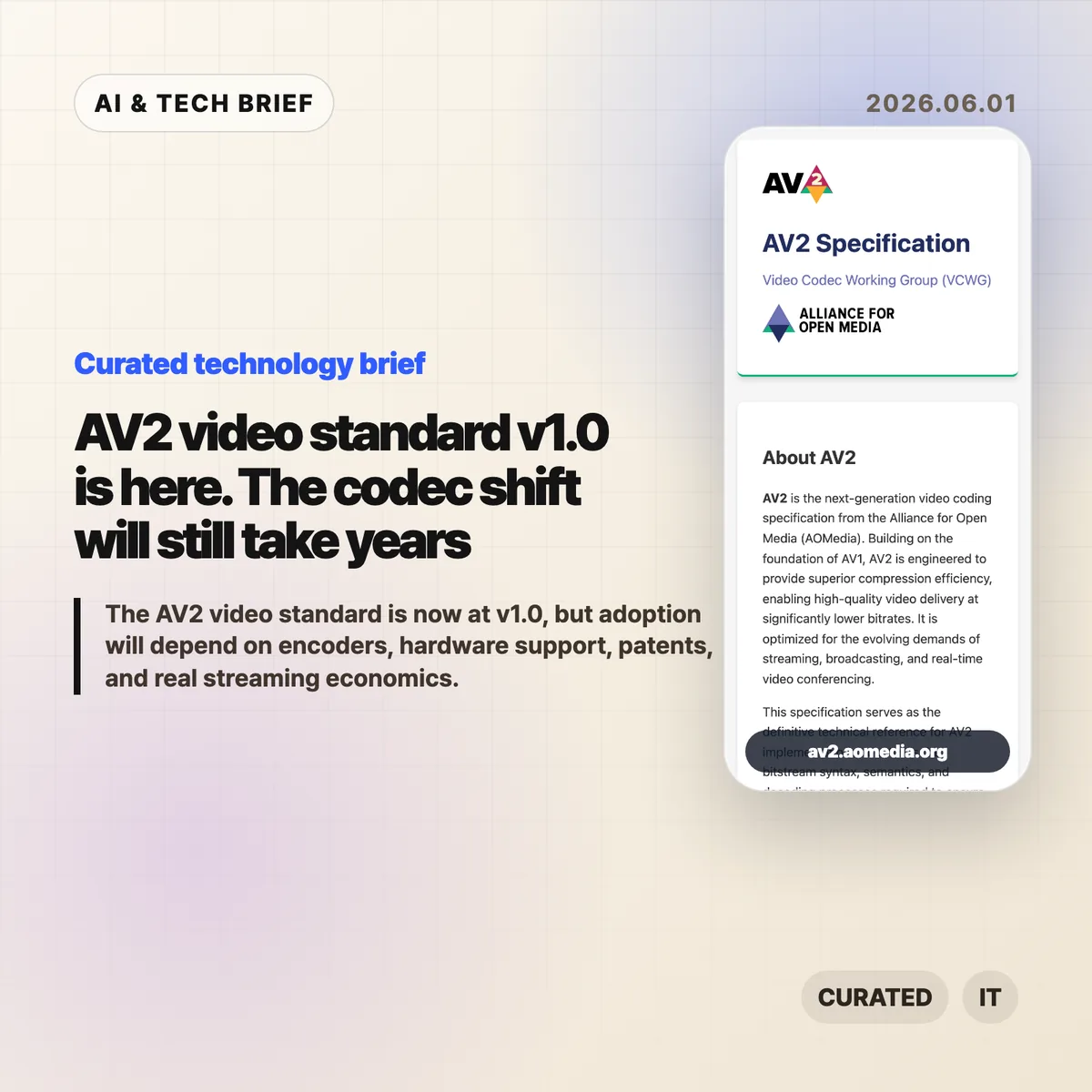
The AV2 video standard has reached its v1.0 specification, giving codec implementers a fixed technical target after years of AV1 deployment work. That matters for streaming platforms, video apps, browsers, chip vendors, and anyone paying real money to store and deliver high-resolution video. It does not mean AV2 videos will suddenly play everywhere next month.
Table of Contents
The short version
- AOMedia has published the AV2 v1.0.0 bitstream and decoding process specification, along with AVM v1.0.0 reference software.
- AV2 is positioned as the successor to AV1, with better compression efficiency and support for streaming, broadcasting, video conferencing, AR/VR, screen content, and multi-program delivery.
- The useful question is adoption speed. Reference software can prove correctness, but production encoders, decoder support, silicon, and patents will decide whether AV2 becomes a mainstream format.
- Hacker News discussion is mostly practical: better compression is welcome, but encoding speed and hardware acceleration will matter more than the announcement itself.
What happened
AOMedia published the AV2 specification site for v1.0.0. The page describes AV2 as a next-generation video coding specification that builds on AV1 and targets lower bitrates for high-quality video delivery. The specification covers bitstream syntax, semantics, and decoding behavior so independent implementations can aim at the same format.
The release also points implementers to AVM, the AOMedia Video Model reference software, tagged at v1.0.0 on GitHub. That is important, but it is easy to misread. Reference software is there to define and test the format. It is not the same thing as a fast encoder that a streaming service can run at scale.
AOMedia also calls out use cases beyond ordinary movie streaming: broadcasting, real-time video conferencing, AR/VR, split-screen delivery of multiple programs, screen content, and a wider visual quality range. Those are the areas where a codec change can affect product design, not only bandwidth bills.
Why this is worth watching
The codec market moves slowly because every layer has to line up. A streaming provider can experiment with AV2 in a lab, but broad use needs encoders that are fast enough, decoders that are cheap enough to run, and hardware support across phones, TVs, laptops, browsers, and set-top boxes.
AV1 showed the pattern. It became useful before it became universal. Big platforms could justify extra encoding work on popular videos because delivery savings compound over many views. Smaller platforms and user-generated video apps face a harder tradeoff: long upload processing times, extra fallback encodes, and battery cost can erase the storage savings.
That is why the AV2 video standard is worth tracking now, even if it is not a near-term migration plan. A fixed v1.0 spec lets encoder vendors, browser teams, chip designers, and media toolchains start working against a stable target. The first real signals will come from production encoder projects, FFmpeg-related tooling, browser experiments, and silicon roadmaps.
For more briefings on web and media infrastructure, the IT & AI archive is the best place to follow related updates.
What Hacker News readers are arguing about
The Hacker News thread is less excited about the press-release part and more focused on deployment math. One repeated estimate in the discussion is that AV2 could offer roughly 20-30% efficiency gains over AV1, but commenters treat that as only one part of the story.
The strongest skeptical camp argues that software encoding and decoding costs are still a blocker for many real products. A small site operator described AV1 as expensive for both servers and clients, especially when a platform still needs to create an H.264 fallback while users wait for uploads to finish processing. For that kind of service, better compression does not help much if the workflow adds delay and duplicate storage.
Another camp argues that the current AV2 encoder is reference software, so poor speed today should not be judged like a production encoder. Now that the spec is frozen, encoder teams can optimize against it. Even there, commenters mostly agree that real-time use cases such as video calls, camera recording, game streaming, and mobile capture will need hardware help.
The most interesting technical thread is multi-stream support. Several commenters see that as more compelling than raw compression gains, especially for VR, live sports, and transparent video workflows where an alpha channel could travel as a separate stream and be composited later. Others questioned whether that belongs in the codec or the container layer, which is exactly the kind of detail that will matter as implementers start building around the spec.
AV2 video standard adoption timeline
The practical timeline is measured in years. A v1.0 spec in 2026 can lead to experimental software, test vectors, and early toolchain work first. Hardware decode support would likely arrive later, and hardware encode support could take longer because it requires chip area, product planning, and enough demand from camera, conferencing, streaming, and editing workloads.
For builders, that means AV2 should sit on the watchlist rather than the roadmap unless you are already deep in media infrastructure. Track encoder performance, browser flags, FFmpeg support, mobile decode behavior, and patent noise. If you run a video product, the near-term work is probably still AV1 tuning and fallback strategy, not an AV2 migration.
The practical read
Treat the AV2 video standard as a starting gun for implementers, not a shipping guarantee for product teams. If your app delivers video at scale, the v1.0 release is a reason to start a research note: expected bitrate savings, likely hardware timelines, fallback costs, and whether your content mix includes screen sharing, VR, sports, or transparent video.
If you build a smaller video service, wait for production encoders and device support before promising users anything. The painful part of codec adoption is rarely the file format alone. It is the upload queue, battery drain, CDN bill, browser support matrix, and the awkward period where every new format needs an older fallback beside it.