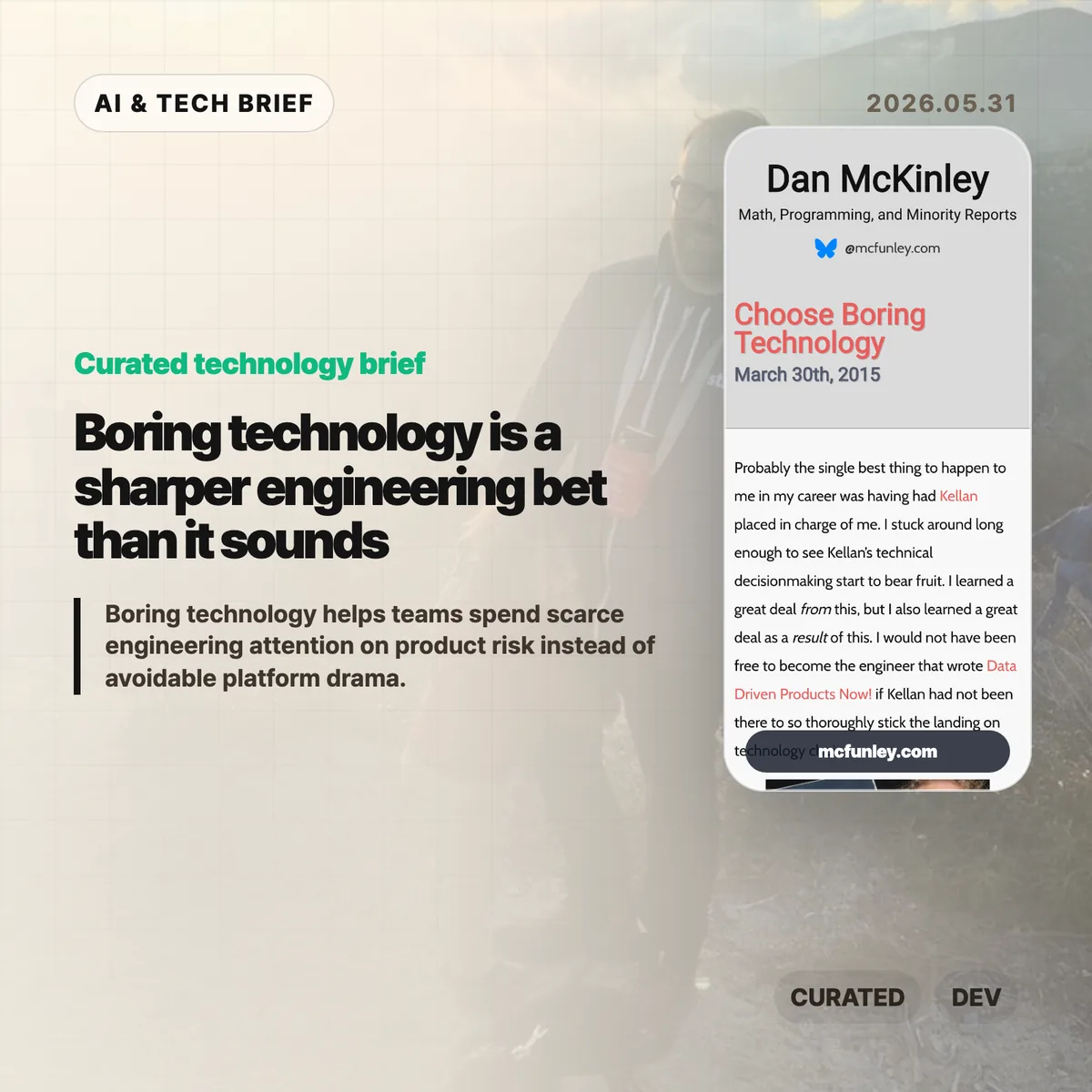
Boring technology is not a plea for timid engineering. Dan McKinley’s 2015 essay argues that teams have a limited budget for novelty, and spending it on databases, queues, deployment plumbing, and service discovery can quietly steal attention from the product itself.
Table of Contents
The short version
- McKinley’s core idea is the “innovation token”: every unfamiliar technology consumes attention, debugging time, hiring capacity, and operational patience.
- “Boring” means well understood, not low quality. MySQL, Postgres, Python, Cron, and similar tools are boring because their failure modes are easier to predict.
- The advice is strongest for startups and small teams. A tool that looks optimal for one subsystem can make the whole company harder to operate.
- New technology still has a place when it is central to the product or removes a real constraint. The bar should be higher than “the demo looked good.”
What happened
Dan McKinley published “Choose Boring Technology” in 2015, drawing on his time at Etsy and on lessons from technical leadership there. The essay has kept circulating because it gives engineers a simple way to talk about platform risk without turning every stack debate into taste warfare.
The memorable frame is that each company gets only a few innovation tokens. Pick Node.js, MongoDB, a new service discovery system, or a homegrown database, and you have spent one. The exact examples have aged, which is part of the point. Some technologies that felt risky in 2015 are ordinary now. The useful question is not whether a named tool is permanently safe or unsafe. It is whether your team already understands the tool’s limits, failure modes, and maintenance cost.
McKinley is not arguing that teams should freeze their stack forever. He is arguing for global optimization. A tool can be the best local answer for one feature and still be the wrong company-level choice once monitoring, testing, hiring, incident response, and handoff costs enter the picture.
Why this is worth watching
The essay reads differently in 2026 because AI infrastructure has made shiny-stack pressure worse. A team can now add a vector database, orchestration framework, eval harness, agent runtime, observability layer, and model gateway before it has proved that the product solves a real user problem.
That does not mean teams should avoid the AI stack. It means the “innovation token” model is even more useful. If the product’s real risk is model quality, workflow fit, or distribution, then spending novelty on routine plumbing is expensive. For more posts on practical tech judgment, see the IT & AI archive.
The sharper reading is this: boring technology buys room to be bold somewhere else. A startup may need a risky model workflow or a new interface pattern. It probably does not need five risky infrastructure choices at the same time.
What Hacker News readers are arguing about
The Hacker News discussion is old but still useful because it shows where the advice meets developer identity. Many readers agreed with the broad lesson: code and infrastructure carry a maintenance cost, and chasing trends can become resume padding disguised as architecture.
The pushback was more interesting than a simple pro-boring consensus. Some commenters argued that code is also an asset, not only a liability, and that speculative learning is part of becoming a better engineer. Others pointed out that “boring” changes with time. Node.js and MongoDB were used as examples of novelty in the original essay, but by the 2021 discussion several readers argued that Node had become mainstream enough to count as boring in many teams.
The practical split is really about context. A consultancy, database company, or developer platform may have a good reason to spend tokens on the core technology it sells. A payments startup or marketplace usually has less reason to invent its own operational substrate. The thread also returns to hiring: familiar stacks are easier to staff, review, debug, and hand off when the first expert leaves.
Boring technology in practice
A useful stack review can be blunt. List every major system that needs special knowledge: database, queue, runtime, deployment layer, auth, observability, AI orchestration, and data pipeline. Then ask which choices are essential to the company’s edge and which ones are merely interesting.
For each nonstandard choice, write down who can operate it during an incident, how it fails under load, how the team tests it, what migration would cost, and whether the same user outcome could be reached with a familiar tool. If nobody can answer those questions, the team may be spending an innovation token without admitting it.
This is especially relevant for app builders and developer tool teams. Product discovery and marketplace rankings tend to reward visible features, but retention often comes from reliability. A tool that lets customers keep their boring stack while adding one valuable capability may be easier to adopt than a product that demands a full platform rethink.
The practical read
Use boring technology as a default, not a religion. If a new tool removes the main bottleneck in your business, test it seriously. If it only makes the architecture diagram look more current, leave it out.
The best version of McKinley’s advice is not anti-innovation. It is anti-waste. Save the weirdness for the part of the product where weirdness actually compounds. Everywhere else, boring is often what lets the team keep shipping.