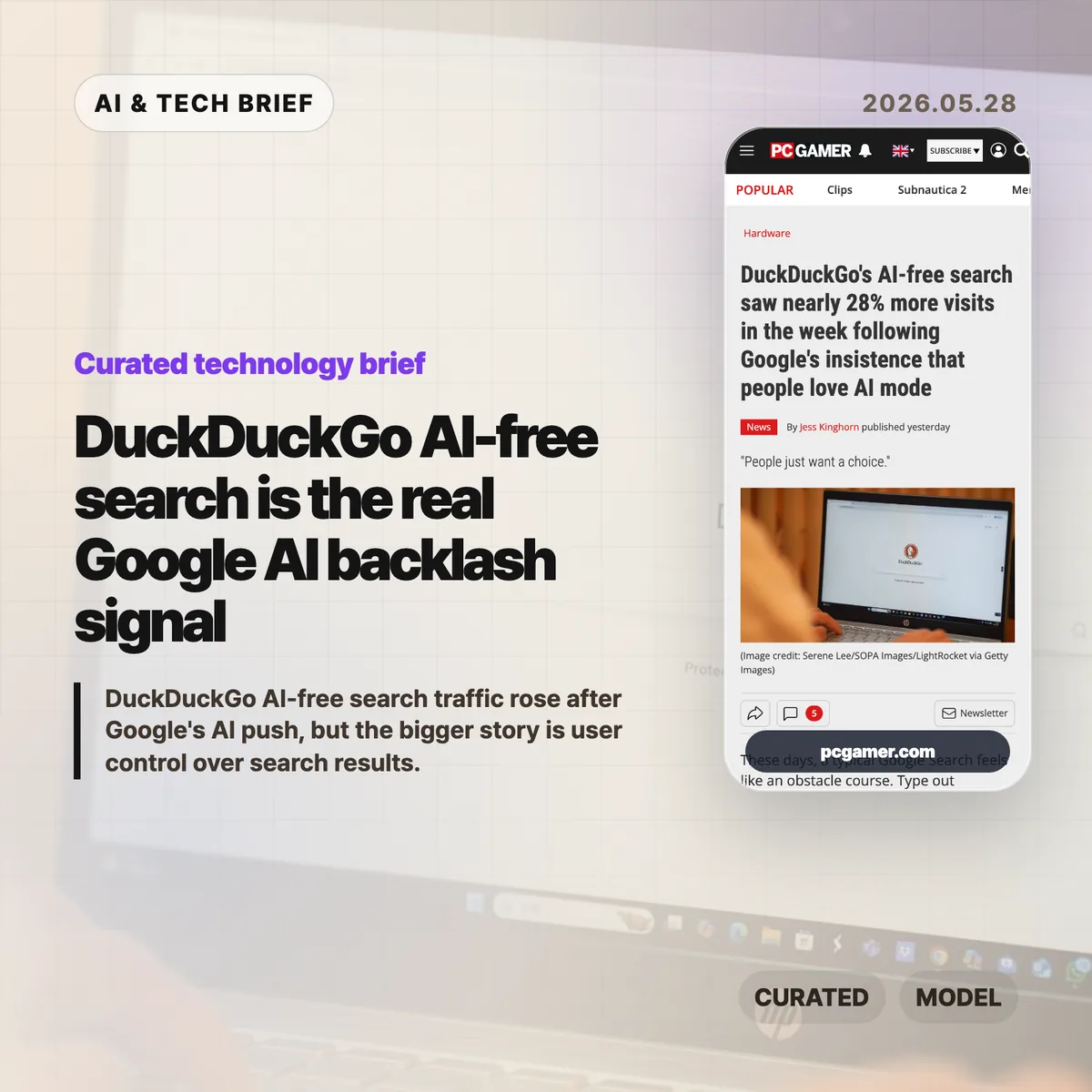
DuckDuckGo AI-free search traffic rose after Google pushed AI Mode and AI Overviews harder into the search experience. The numbers are still small next to Google’s market share, but the reaction points to a product problem: some people want AI answers, and some people want search results without a model stepping in first.
Table of Contents
The short version
- Visits to DuckDuckGo’s AI-free search page reportedly rose by an average of 22.7% week over week from May 20 to May 25, peaking at 27.7% on May 24.
- TechCrunch reported that DuckDuckGo mobile app installs in the US rose 18.1% on average over the same stretch, with a 30.5% peak on May 25.
- This does not make DuckDuckGo a near-term threat to Google Search, which still has a much larger share of the US search market.
- The useful signal is product fatigue: users are reacting less to AI itself than to AI being treated as the default layer in search.
What happened
PC Gamer reported that DuckDuckGo saw a sharp bump in usage around its AI-free search surface after Google kept promoting AI Mode as a direction users supposedly like. DuckDuckGo’s noai page, which gives people a cleaner path to search without AI answers, saw visits rise 22.7% on average week over week from May 20 through May 25. The peak was 27.7% on May 24.
TechCrunch reported a related app-store signal. DuckDuckGo mobile app installs in the US rose 18.1% on average over the same six-day window, and the increase peaked at 30.5% on May 25. Those figures are not a market-share earthquake. They are a behavior change worth watching because they happened around a visible product dispute: Google putting AI answers closer to the center of search, and some users looking for a way around it.
Google has a business reason to keep going. In Alphabet’s Q1 2026 remarks, Sundar Pichai said Search revenue rose 19% year over year and tied part of Google’s momentum to AI experiences such as AI Overviews and AI Mode. From Google’s side, AI search is a growth story. From the user’s side, it can feel like a familiar utility changing its rules without asking.
Why this is worth watching
Search is not a side feature. It is the front door to the web for a lot of people. When AI answers sit above links, the search engine is no longer only helping users find pages. It is deciding when a synthesized answer should come before the open web.
That can be useful. Plenty of queries are simple enough that an answer box saves time. The friction starts when a user wants links, source comparison, official pages, forum threads, product documentation, or a plain list of results. In those moments, an AI answer can feel like an obstacle rather than a shortcut.
The privacy angle also gives DuckDuckGo a cleaner message. DuckDuckGo is not anti-AI across the board. It offers AI chat and summaries in other contexts. Its pitch is closer to control: let the user choose how much AI they want, and do not turn search logs or chats into training material. For people already uneasy about data collection, that distinction is easy to understand.
There is also a lesson for anyone building AI into consumer products. If a feature changes a daily habit, opt-out controls are part of the product, not a settings afterthought. For more coverage of search, AI products, and platform shifts, see the IT & AI archive.
DuckDuckGo AI-free search and user control
DuckDuckGo AI-free search is a useful phrase because it names the demand more clearly than “anti-AI search.” The demand is not for a web frozen in 2015. It is for a visible choice between answer generation and ordinary results.
What Hacker News readers are arguing about
The Hacker News thread was split in a useful way. Some readers had already moved to DuckDuckGo or were trying alternatives because they disliked seeing AI answers in ordinary search. A repeated complaint was not that AI is useless, but that Google Search is where they go for links. If they want a chatbot, they would rather open a dedicated AI product.
Another group defended Google AI Mode. They said it is fast, convenient from the address bar, and good enough for quick factual checks. That camp is not imaginary; it explains why Google’s internal metrics may look positive even while a visible group of users complains loudly.
The strongest skeptical point was about the denominator. A 28% increase sounds large, but DuckDuckGo starts from a much smaller base than Google. Several commenters argued that the headline could overstate the competitive impact if readers treat a relative increase as proof of a broad search migration.
The more practical thread was about controls. Readers kept coming back to the same distinction: AI can be useful when asked for, annoying when forced, and worrying when it changes what counts as a search result. That is the part product teams should notice.
The practical read
DuckDuckGo is not suddenly replacing Google Search. The safer read is that AI search has entered the backlash phase that most default-on product changes eventually face.
For Google, the risk is not that every frustrated user leaves tomorrow. The risk is training people to keep a second search engine nearby for cases where AI gets in the way. That is a small habit change at first, but it weakens the assumption that Google is the only search box worth using.
For DuckDuckGo and other search apps, the opening is clear but narrow. Privacy and AI opt-out messaging can bring people in. The hard part is keeping them when results quality, local search, maps, shopping, and vertical search matter. A search engine can win a protest click and still lose the daily habit.
For builders, the rule is simple enough: do not confuse adoption with consent. If an AI feature is genuinely useful, people will use it when the path is clear. If they have to fight the interface to get back to the old behavior, the alternative with a simple off switch starts to look better.