Tag: AI Coding

  • LLM oriented engineering puts human context first

    LLM oriented engineering puts human context first

    LLM oriented engineering is less about making models write more code and more about protecting the parts of software work that still need human judgment. Yair Weinberger, writing from his work at Reindeer, argues that the scarce resource in AI-assisted teams is not typing speed. It is human context: the time and attention needed to understand architecture, say no to bad API changes, and keep generated work from spreading through the codebase.

    The short version

    • Weinberger frames human attention as the real bottleneck: LLMs can produce code, comments, documents, and PRs faster than people can read them.
    • His practical answer is stricter modeling discipline, especially around APIs and component boundaries.
    • Human code review alone does not scale when AI-generated pull requests grow, so teams need linters, LLM judges, tests, and smaller PRs.
    • PMs can use LLMs to prototype in isolated repositories, but product ideas that touch customers still need a slower modeling path before they reach production.
    • The sharpest claim is that AI multiplies both good and bad engineering habits. Weak structure now turns into debt faster.

    What happened

    Weinberger published a long X post under the phrase “LLM Oriented Engineering,” based on roughly 18 months of thinking about how Reindeer builds product in the LLM era. The post is not a tooling launch or a benchmark. It is a working theory for how a software organization should behave once generated code, documents, and PR descriptions become cheap.

    The starting point is simple: people have limited context windows too. If LLMs fill the organization with bloated comments, verbose documents, and sprawling pull requests, the next human reviewer gets less signal. Then the next model reads that noisy context and copies the pattern.

    That is why Weinberger puts modeling at the center. Translating a customer user journey into API flows, components, and boundaries is still human work. A model can add a convenient field to an API in seconds. The team may then have to support that field as a public contract for years.

    Why this is worth watching

    A lot of AI coding discussion still treats productivity as the main question. The more interesting question is what happens after productivity rises. LLM oriented engineering gives that problem a name: the team does not run out of code, it runs out of readable context.

    The post also pushes back on the idea that review can stay mostly human. Weinberger’s view is blunt: people cannot beat LLM output volume by reading harder. Absolute rules, such as forbidden service dependencies, belong in linters. Softer contracts can be checked by LLM judges on clean context. Humans should spend their attention on modeling changes, API changes, and other load-bearing decisions.

    One useful phrase from the post is “padded rooms.” These are parts of the system where LLMs can move fast because mistakes do not create long-term dependencies. Customer-specific work and experiments can live there. Core architecture should not.

    That distinction matters for anyone building coding agents or developer tooling. The product does not only need a better autocomplete loop. It needs workflows that separate throwaway experiments from production contracts, and it needs review surfaces that make human attention easier to spend. For more coverage of AI and developer tools, the IT & AI archive is the closest internal reference point.

    What the discussion is missing

    I could not find a matching Hacker News thread for this specific post, so there is no public HN argument to summarize. The missing debate is still obvious enough: Weinberger is describing a company that already has a strong internal engineering culture, strong tests, and enough discipline to keep prototypes away from production.

    That is the hard part to generalize. A small team can say “use padded rooms” and still let customer work leak into core code because the customer is loud, the deadline is real, and the AI-generated patch appears to work. A larger team can add LLM judges and still end up trusting a model that checks the wrong thing.

    The post would be stronger with concrete examples of the enforcement layer: what a useful LLM judge prompt checks, what gets blocked by linters, and how the team decides that an API change is load-bearing enough for human review. Without those examples, the argument is directionally useful but still a playbook outline.

    LLM oriented engineering, in practice

    There are five habits worth pulling out of the post.

    First, keep organizational text tight. If a comment or PR description explains history instead of the result, it probably costs more attention than it saves.

    Second, treat APIs as contracts. A field that helps one generated patch can become a long-running support burden.

    Third, make pull requests small enough to read. If a reviewer cannot hold the change in their head, the approval is mostly theater.

    Fourth, invest in reward functions. In software work, that means useful tests, end-to-end coverage where it matters, evals for LLM-backed features, and automated review that starts from clean context.

    Fifth, isolate experiments. Let PMs and agents build fast demos, but make production adoption a separate modeling decision.

    None of this is glamorous. That is the point. LLM oriented engineering is not a new layer of magic on top of software teams. It is old engineering hygiene under much higher output pressure.

    The practical read

    If your team is adopting coding agents, start by mapping which parts of your codebase are load-bearing. APIs, shared data models, permission boundaries, and core workflows should get slower review. UI experiments, customer-specific adapters, and disposable prototypes can move faster if they stay isolated.

    Then look at the review burden. If AI has made PRs bigger, comments longer, and docs noisier, you have not gained as much leverage as it looks. You have moved work from typing to comprehension.

    The practical test is simple: can a new engineer, or a clean-context review agent, understand why the system is shaped the way it is? If not, more generated code will make the team feel faster while making the product harder to change.
    Sources

  • Domain expertise is the AI coding moat

    Domain expertise is the AI coding moat

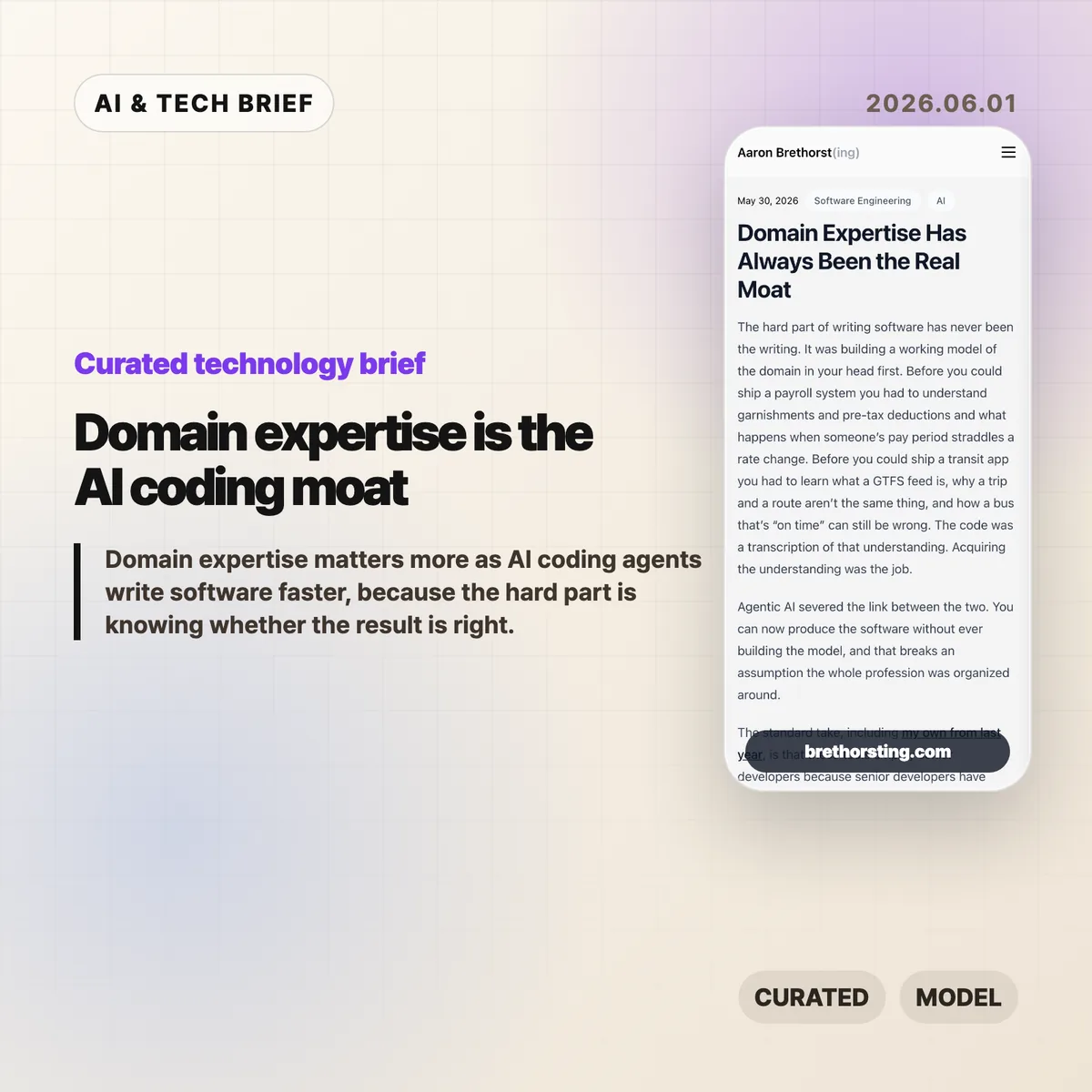
    Domain expertise is becoming more valuable as AI coding agents make software easier to produce. Aaron Brethorst’s argument is simple and uncomfortable: the bottleneck moves from writing the code to knowing whether the thing the code does is correct.

    The short version: domain expertise

    • AI coding agents lower the cost of implementation, but they do not automatically know the messy rules inside payroll, transit, insurance, logistics, or clinical billing.
    • Domain expertise matters because the expert can spot a plausible answer that is wrong before it turns into a costly system.
    • The strongest engineer in this setup is not the fastest prompt writer. It is the person who can judge the code and the real-world result.
    • Hacker News readers mostly agreed with the premise, but pushed back on the idea that domain experts can easily explain their own rules to an AI system.

    What happened

    Brethorst’s essay argues that software has always depended on a mental model of the domain. A payroll system is hard because of garnishments, deductions, rate changes, and edge cases. A transit app is hard because routes, trips, schedules, and rider expectations do not line up cleanly.

    In that view, code is the transcription layer. The harder work is learning enough of the domain to know what the software should do.

    AI coding agents weaken the old link between understanding and implementation. A person can now ask an agent to build screens, APIs, tests, and deployment scripts without years of programming practice. That helps domain experts, because the missing piece for many of them was code production. It does less for a generalist engineer who lacks the domain model and cannot tell whether a generated output is actually right.

    That distinction matters for teams following AI and software engineering closely in the IT & AI archive. Faster output is useful only when the organization has someone who can define and verify correctness.

    Why this is worth watching

    The essay lands because it pushes against a lazy version of the AI coding story. If code gets cheaper, the valuable work does not disappear. It moves closer to judgment.

    A logistics dispatcher may not read a stack trace, but they can look at a generated schedule and know that a driver cannot legally work that shift. A clinical coder may not care how the rules engine is structured, but they can see when a claim is likely to be denied. That is not generic “business context.” It is accumulated pattern recognition from years of seeing inputs, outputs, exceptions, and consequences.

    This is also a career argument. Senior developers still need architecture, reliability, testing, and incident judgment. But if their only advantage is turning clear requirements into clean code, that advantage is getting thinner. The rarer combination is engineering skill plus a working model of a real domain.

    For product teams, the practical question is where domain expertise sits in the AI workflow. If experts only review the product after engineers and agents have already built it, the process will keep producing polished wrong answers. The expert needs to shape tests, examples, acceptance criteria, and failure cases early.

    What Hacker News readers are arguing about

    The Hacker News discussion was less about whether domain expertise matters and more about whether domain experts can make their knowledge explicit enough for software.

    One strong objection was that verifying an answer is different from explaining how to generate it. Several commenters who had worked with finance or accounting teams said experts often know a rule when they see it, but struggle to describe it fully. That led to a useful thread around tacit knowledge and Polanyi’s paradox: people can know more than they can explain.

    Another camp argued that requirements work has always been the real software job. In small companies and internal systems, refining what the system should do often takes more time than writing the code. AI may make this more obvious rather than make it new.

    There was also a builder-friendly angle. Some commenters said AI can help engineers learn a domain faster because it removes boilerplate and lets them build experiments quickly. A few mentioned domain-specific languages as a better bridge: instead of expecting experts to write software, give them a constrained language that encodes the rules and can be tested against past cases.

    The useful skepticism is this: domain experts are not automatically good product designers, requirements writers, or system builders. The win probably comes from tighter collaboration, where experts supply examples and corrections while engineers turn that knowledge into reliable systems.

    The practical read

    If you run an engineering team, do not measure AI coding only by tickets closed or lines generated. Add domain validation to the workflow. Ask who owns the examples, who writes the edge-case tests, and who can reject a result that looks reasonable but fails a real rule.

    If you are a developer, the career move is not to panic about code generation. Pick a domain where mistakes matter and learn it seriously. Billing, compliance, logistics, security operations, financial workflows, health care administration, industrial systems, and public-sector processes all have rules that are hard to fake.

    The near-term advantage belongs to people who can ask an AI agent for working software, then say with evidence whether the output is correct. Domain expertise is the moat because correctness is still tied to the world outside the editor.

    Sources

  • Cursor Developer Habits Report shows AI coding is changing shape

    Cursor Developer Habits Report shows AI coding is changing shape

    Source: The Cursor Developer Habits Report

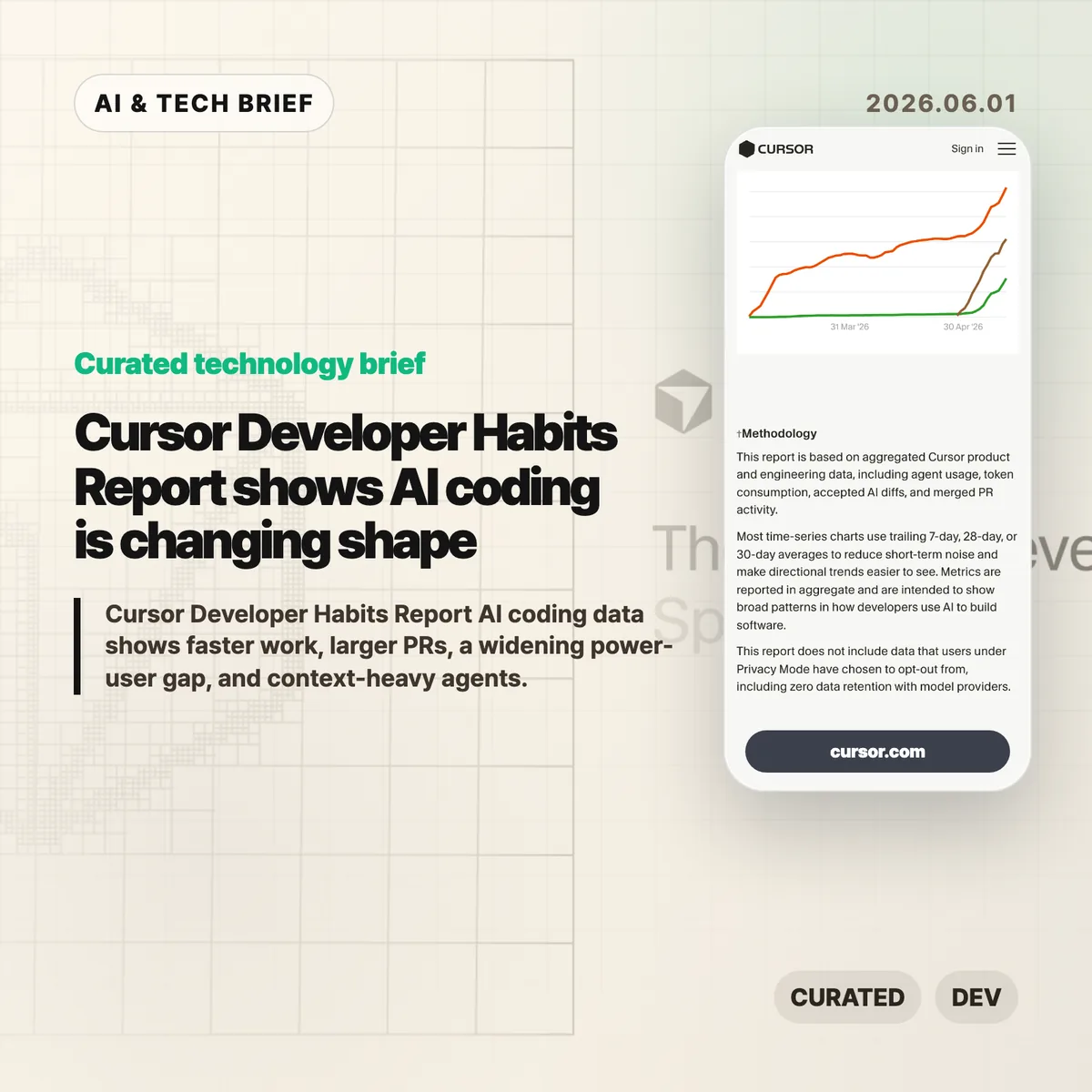
    AI coding tools are no longer just making autocomplete feel smarter. Cursor’s Spring 2026 Developer Habits Report points to something messier: more code, larger PRs, deeper agent sessions, and a widening gap between casual users and people who have turned agents into a real workflow.

    The short version

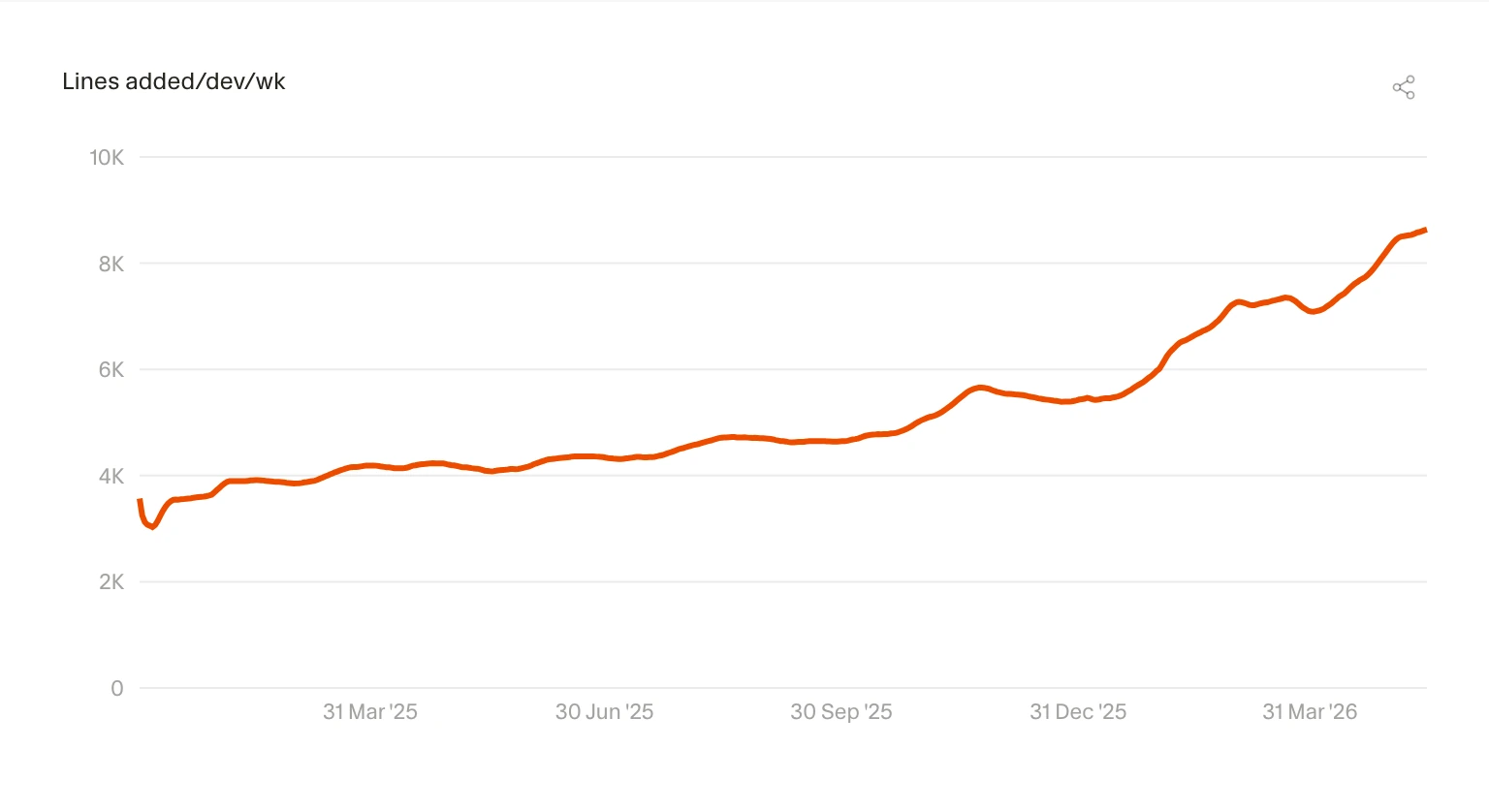
    • The Cursor Developer Habits Report says lines added per developer per week rose from 3.6K in early 2025 to 8.6K by May 2026.
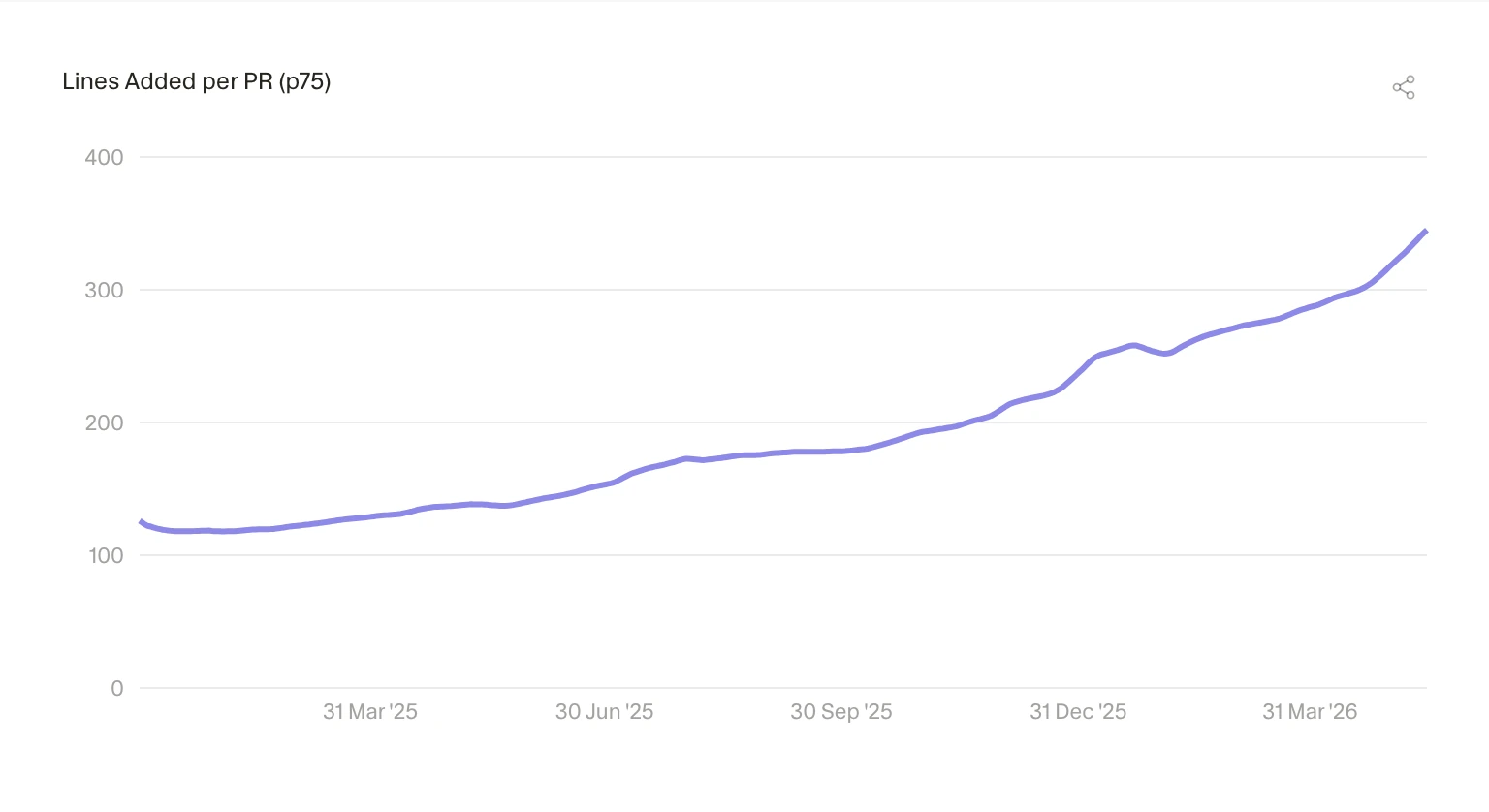
    • PRs are getting much larger. The p75 lines added per PR moved from 125.86 to 345.02.
    • Big PRs are less rare now: merged PRs with at least 1,000 changed lines rose from 8.0% to 13.8%.
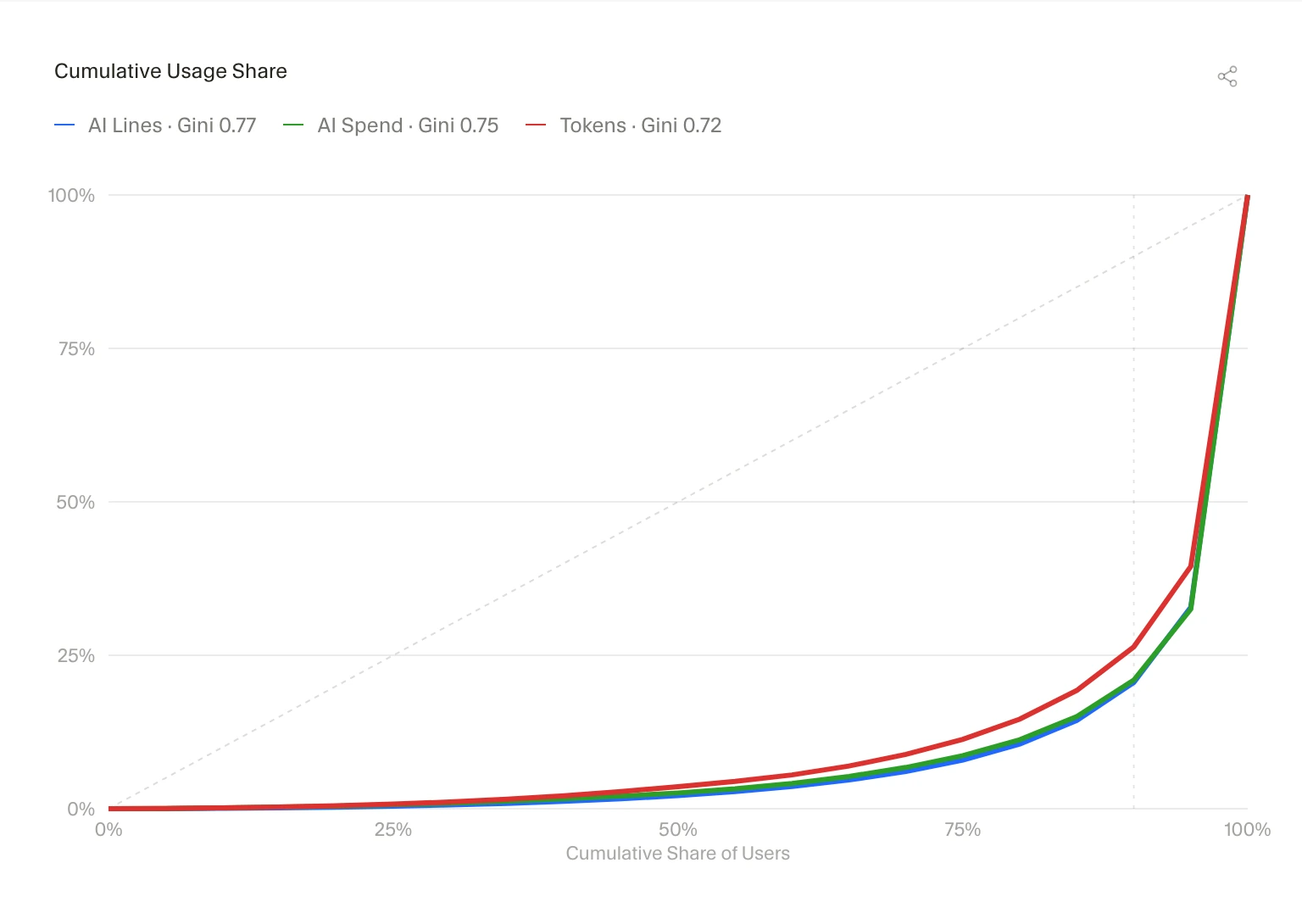
    • AI usage is concentrated. Cursor reports Gini scores of 0.77 for AI lines, 0.75 for AI spend, and 0.72 for token consumption.
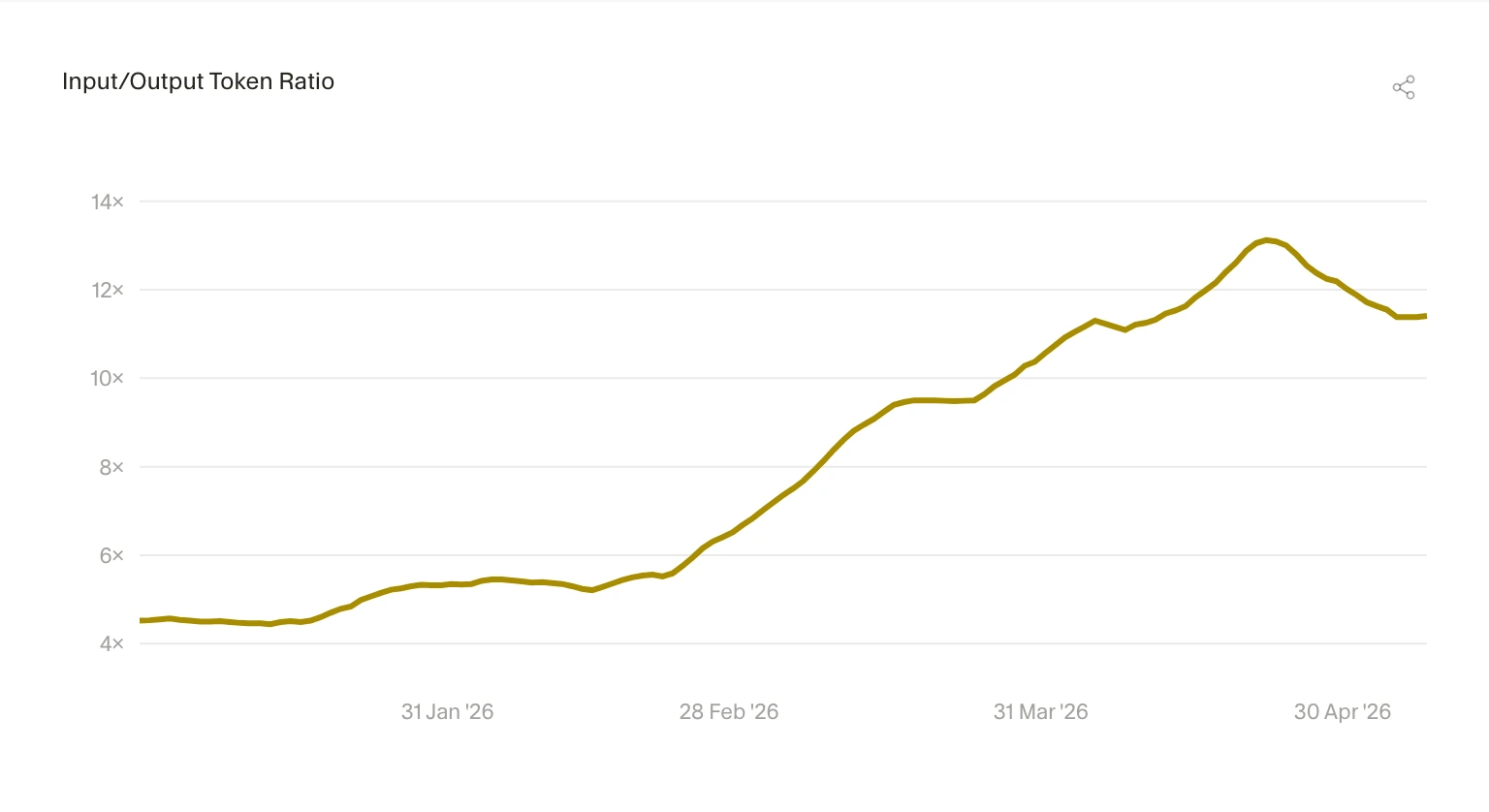
    • The input/output token ratio rose from 4.52× to 11.41×, which means agents are reading far more before they write.

    What happened

    Cursor published a product-data report on how developers are using AI inside its coding environment. The headline number is easy to understand: developers are adding more code. But the more useful signal is that the unit of work is getting bigger.

    Lines added per developer per week rose from 3.6K to 8.6K. That is a big jump. It is also a dangerous number to overread. More lines can mean more output. They can also mean more churn, more review load, or more code that somebody has to clean up later.

    Cursor chart showing weekly lines added per developer
    Cursor chart showing weekly lines added per developer

    Source: The Cursor Developer Habits Report

    The PR data is harder to ignore. The p75 lines added per PR went from 125.86 to 345.02, and the share of merged PRs with at least 1,000 changed lines rose from 8.0% to 13.8%. That changes the reviewer’s job. A larger diff needs a clearer intent, better tests, and a smaller blast radius.

    Cursor chart showing p75 lines added per pull request
    Cursor chart showing p75 lines added per pull request

    Source: The Cursor Developer Habits Report

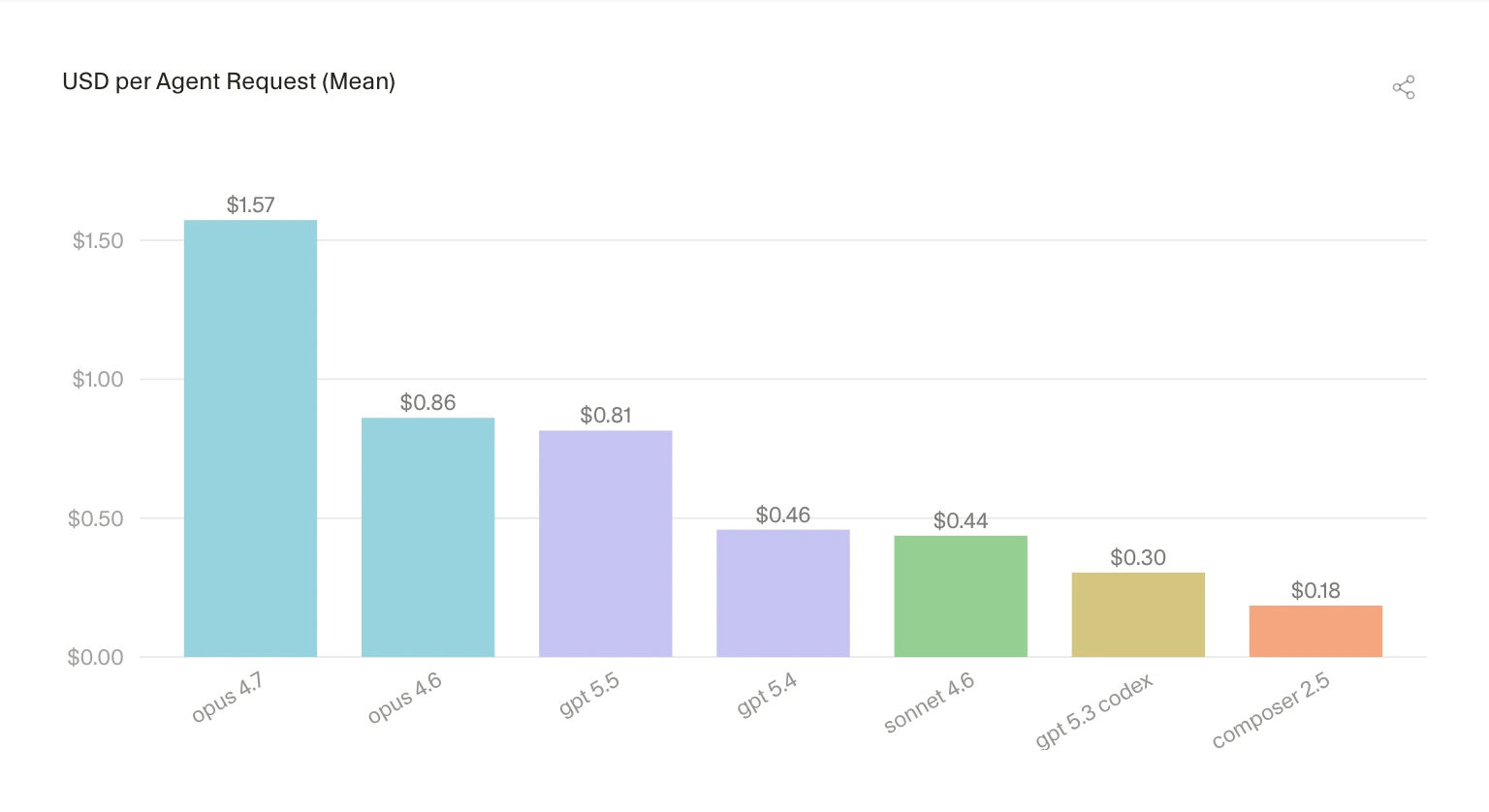
    Cost is part of the story too. Cursor shows average agent request cost varying from $1.57 for opus 4.7 to $0.18 for composer 2.5. The gap gets narrower when measured by accepted added line, but it does not go away. Model choice now affects product quality and margins at the same time.

    Cursor chart comparing average agent request cost by model
    Cursor chart comparing average agent request cost by model

    Source: The Cursor Developer Habits Report

    Why this is worth watching

    The Cursor Developer Habits Report is useful because it shows the awkward middle stage of AI coding. The tools are good enough to change how people work, but not clean enough to remove the need for discipline.

    Bigger PRs are not automatically better. Deeper agent sessions are not automatically safer. Cursor also reports that the 60-minute survival share for accepted AI lines rose from roughly 76% to 81%, which is a decent signal. But a line surviving for an hour is not the same as a line staying cheap to maintain for six months.

    The power-user gap may be the most important part. If the top users learn how to scope work, feed context, inspect diffs, and run checks, their curve bends faster than everyone else’s. Buying the tool does not spread that skill evenly across a team.

    Cursor chart showing AI usage concentration and Gini scores
    Cursor chart showing AI usage concentration and Gini scores

    Source: The Cursor Developer Habits Report

    AI coding notes for builders

    For developer-tool teams, the context numbers are the part to stare at. The input/output token ratio climbed above 11×. That suggests the agent experience is becoming a reading problem as much as a writing problem.

    Cursor chart showing input to output token ratio growth
    Cursor chart showing input to output token ratio growth

    Source: The Cursor Developer Habits Report

    Repo maps, search, cache behavior, tool calls, terminal output, and review surfaces may matter as much as the base model. Users do not experience “model quality” in the abstract. They notice whether the agent understood their codebase or confidently edited the wrong thing.

    What the discussion is missing

    Cursor’s data comes from real product usage, which makes it more useful than a survey. It is still Cursor’s own user base. Treat it as a strong signal, not an industry-wide average.

    The missing comparison is downstream quality. Defect rates. Rollbacks. Review time. Test coverage. Maintenance cost after AI-assisted changes land. Lines added and PR size are easy to chart. Engineering health is where the bill shows up later.

    The practical read

    Engineering leaders should watch review systems alongside AI adoption. If agents make PRs larger, teams need sharper change descriptions, better test evidence, and a habit of splitting risky work before it becomes unreadable.

    Individual developers should treat AI coding as a workflow skill. Ask for smaller changes. Provide the files that matter. Read the diff. Run the tests. Reject output quickly when it drifts. That sounds boring, but that is the difference between speed and cleanup.

    For more AI and developer-tool coverage, see the AI & Technology archive.

    Sources

  • Claude Opus 4.8 is a quieter bet on AI coding teamwork

    Claude Opus 4.8 is a quieter bet on AI coding teamwork

    Claude Opus 4.8 is Anthropic’s latest Opus model, and the more interesting part is not a single benchmark jump. The release points to a different priority for AI coding tools: fewer unsupported claims, larger Claude Code jobs, clearer cost controls, and API behavior that fits long-running agent work.

    The short version

    • Anthropic says Claude Opus 4.8 improves coding, agentic tasks, reasoning, and professional work while keeping regular Opus 4.7 pricing at $5 per million input tokens and $25 per million output tokens.
    • The company says Opus 4.8 is around four times less likely than Opus 4.7 to let flaws in its own code pass without comment.
    • Claude Code is getting dynamic workflows, a research preview feature that can plan large jobs, run hundreds of parallel subagents, verify outputs, and report back.
    • Effort control lets users trade speed and rate-limit usage against deeper reasoning, while fast mode now runs at 2.5x speed and costs less than before.
    • The Hacker News thread reads less like a celebration and more like a stress test: many readers see a modest update, but builders are watching the workflow changes.

    What happened

    Anthropic introduced Claude Opus 4.8 as an upgrade to Opus 4.7, available now through claude.ai, Claude Code, and the Claude API. The company frames the model as stronger across coding, agentic skills, reasoning, and professional work, but it also says users should expect a “modest but tangible” step over the prior version.

    The regular API price stays the same: $5 per million input tokens and $25 per million output tokens. Fast mode is priced at $10 per million input tokens and $50 per million output tokens. Anthropic says fast mode can work at 2.5x the speed and is now three times cheaper than it was for earlier models.

    The release also changes the product around the model. Claude Code gets dynamic workflows for very large codebase tasks. claude.ai and Cowork get effort control. The Messages API now accepts system entries inside the messages array, so developers can update instructions during a task without breaking prompt caching or disguising the change as a user message.

    Why this is worth watching

    The useful signal in Claude Opus 4.8 is that Anthropic is optimizing around collaboration, not only raw answer quality. That matters because AI coding failures often come from confidence at the wrong moment: the model says a migration is done, misses a test failure, or keeps moving after the plan has gone stale.

    Anthropic’s honesty claim is therefore worth watching, even if the phrase sounds a little odd in a model release. If Opus 4.8 really flags uncertainty more often and catches more of its own code defects, teams may be able to give Claude Code larger chunks of work without turning every run into a manual audit.

    The product changes point in the same direction. Dynamic workflows are available in Claude Code for Enterprise, Team, and Max plans. The feature lets Claude plan a large task, split it across many subagents, and check the work before returning it. For readers who track AI tooling beyond this single release, the broader IT & AI archive is a useful place to follow how model updates are turning into workflow products.

    Claude Opus 4.8 in practice

    For developers, Claude Opus 4.8 is less about replacing the current coding stack and more about changing where the model sits in the process. Autocomplete lives inside a narrow edit loop. Claude Code’s dynamic workflows move the model closer to project manager, migration assistant, and reviewer.

    That shift creates a harder evaluation problem. A model that writes one function can be judged by tests and review. A model that runs a multi-step migration across hundreds of thousands of lines needs better guardrails: scoped permissions, clear rollback points, test gates, logging, and a human who knows when to stop the run.

    Effort control also matters here. Low effort is the right default for routine answers. Higher effort makes more sense when the model is planning, touching many files, or making decisions that cost money if they are wrong. The control is not glamorous, but it is the kind of product detail teams need before they trust AI agents with bigger jobs.

    What Hacker News readers are arguing about

    The Hacker News discussion is skeptical, but not in a simple anti-AI way. The most common reaction is that Claude Opus 4.8 feels incremental. Several commenters point to Anthropic’s own “modest but tangible” phrasing and argue that benchmark tables no longer tell them much because many public evals feel saturated.

    A second thread is about language. Anthropic’s emphasis on model “honesty” annoyed some readers, who felt the company talks about models as if they were organisms being observed in the wild. That led to a more technical argument about whether models are “grown” or “built,” and how much researchers can really explain about why a trained model behaves the way it does.

    The builder-side reading is more practical. Same regular price, cheaper fast mode, effort control, and dynamic workflows are the pieces people can actually use. The useful objection is that bigger agentic runs raise the cost of a bad assumption. If Claude can run hundreds of subagents, the test suite, permission model, and review process become part of the product, not afterthoughts.

    The practical read

    If you already use Claude for coding, Claude Opus 4.8 is worth testing on the tasks where earlier models were annoying rather than impossible: long refactors, migration planning, bug hunts, and code review loops where the model had to admit uncertainty. Do not judge it only on one-shot prompts.

    For teams, the first test should be operational. Compare Opus 4.8 against Opus 4.7 on the same repository, with the same tests, the same token budget, and the same review checklist. Track where it stops, where it asks for clarification, and where it claims success too early.

    For product builders, the release says something broader about AI tool competition. The next useful layer may be less about a smarter chat box and more about controls around the model: effort settings, fast modes, mid-task instruction updates, subagent orchestration, and honest failure reporting. Claude Opus 4.8 is a good release to study if your product depends on developers trusting an agent for work that lasts longer than a single prompt.

    Sources